
The Leapfrog Equation: Why Modern Growth Demands System Redesign, Not Incrementalism
In the boardroom, “Leapfrogging” is often treated as a buzzword—a hollow aspiration for sudden success. But after a decade in financial consulting and strategic restructuring, I’ve learned that a true Leapfrog isn’t a stroke of luck. It is an engineering feat.
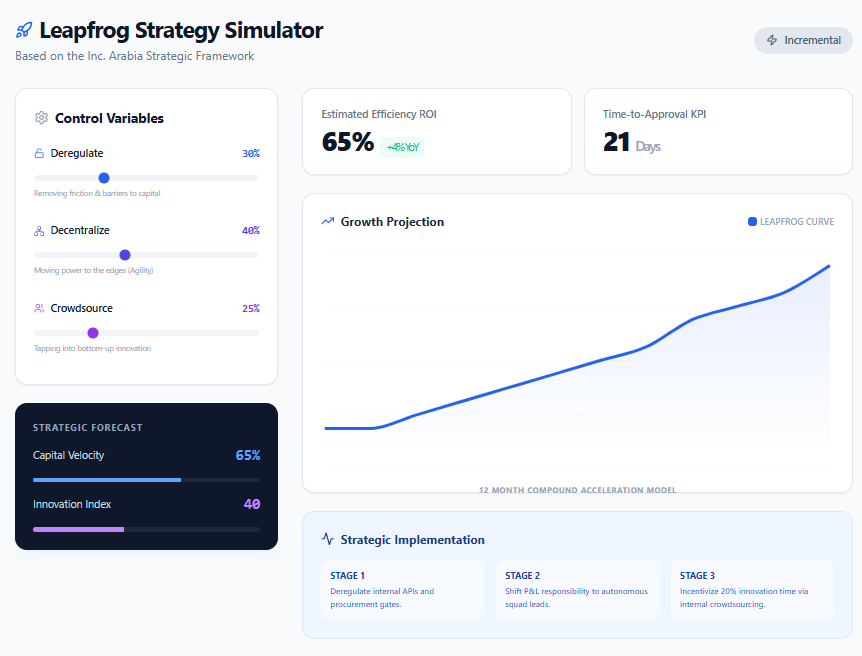
It occurs only when a leader stops trying to optimize a broken machine and starts designing a new one. To move from 5% year-on-year growth to a 10x disruption, you need a specific, high-velocity formula: Deregulate + Decentralize + Crowdsource.
Applied with institutional intelligence rather than chaotic abandon, this equation becomes the ultimate engine for capital velocity.
1. Deregulate: Removing the “Friction Tax”
Deregulation is often misunderstood as the removal of rules. In a high-performance organization, it is the removal of the rules that protect the past at the expense of the future.
When a system is over-regulated, it suffers from:
- High barriers to entry for new ideas.
- Innovation paralysis due to “compliance-first” thinking.
- Sluggish capital cycles where money sits idle waiting for approvals.
Case Study: Estonia. Post-independence, Estonia didn’t try to mimic the heavy bureaucracies of Western Europe. They digitized the entire state apparatus, removed administrative friction, and allowed a company to be founded in minutes.
- The Result: One of the world’s highest concentrations of startups per capita and a massive influx of global “e-residents.”
The Financial Perspective: Lowering friction is equivalent to increasing the “velocity of money” within your P&L. Reducing bureaucracy directly correlates to a higher ROI on economic activity.
2. Decentralize: Power to the Edges
Centralization kills speed. In an era where information travels instantly, waiting for “Headquarters” to decide is a competitive death sentence.
Case Study: Singapore Singapore’s growth was fueled by giving massive executive autonomy to specialized agencies (PSA, HDB, GIC). Each unit operates almost like a sovereign P&L center.
The Strategic Shift: Decentralization means every unit is responsible for its results, not for satisfying a central bureaucracy. It replaces “permission” with “accountability.” When power is at the edges, the organization becomes an agile network rather than a slow-moving monolith.
3. Crowdsource: The Bottom-Up Innovation Engine
The most disruptive ideas rarely come from a top-down mandate; they emerge from the people closest to the problem.
The Google Model: The famous “20% time” policy didn’t just boost morale; it created multi-billion dollar assets like Gmail and AdSense. By allowing employees to build outside the formal structure, Google effectively crowdsourced its own future.
How to Crowdsource internally:
- Participatory Budgeting: Let teams bid for resources based on peer-reviewed potential.
- Internal Sandboxes: Create safe zones where “radical” ideas can be tested without risking the core business.
The 5-Stage Leapfrog Framework
- Friction Audit: Review every internal policy. If it doesn’t shorten the “Time-to-Approval,” it is a tax on your growth.
- Total Digitization: Unified data and open internal APIs are the nervous system of a leapfrog organization.
- Financial Empowerment: Shift from centralized budgets to decentralized accountability.
- The Sandbox Economy: Fund short-term experiments. Failure is cheap; stagnation is expensive.
- Human Capital Recycling: Rapid upskilling and performance-based incentives that reward risk-taking.
Why Most Leapfrog Attempts Fail
- Political vs. Economic Goals: The shift is done for optics, not efficiency.
- No Institutional Guardrails: Deregulation without “smart oversight” leads to volatility.
- Incentive Mismatch: If you ask for innovation but punish failure, you will get neither.
The Bottom Line
In pure financial terms: Leapfrog = Increased Capital Velocity + Reduced Transaction Costs + Exponential Labor Productivity.
If you can master these three variables, you aren’t just competing in the market—you are redefining it.
The Question for You: Are you building for a 10% improvement, or are you ready to redesign the system? The math of the future doesn’t favor the cautious; it favors the frictionless.