
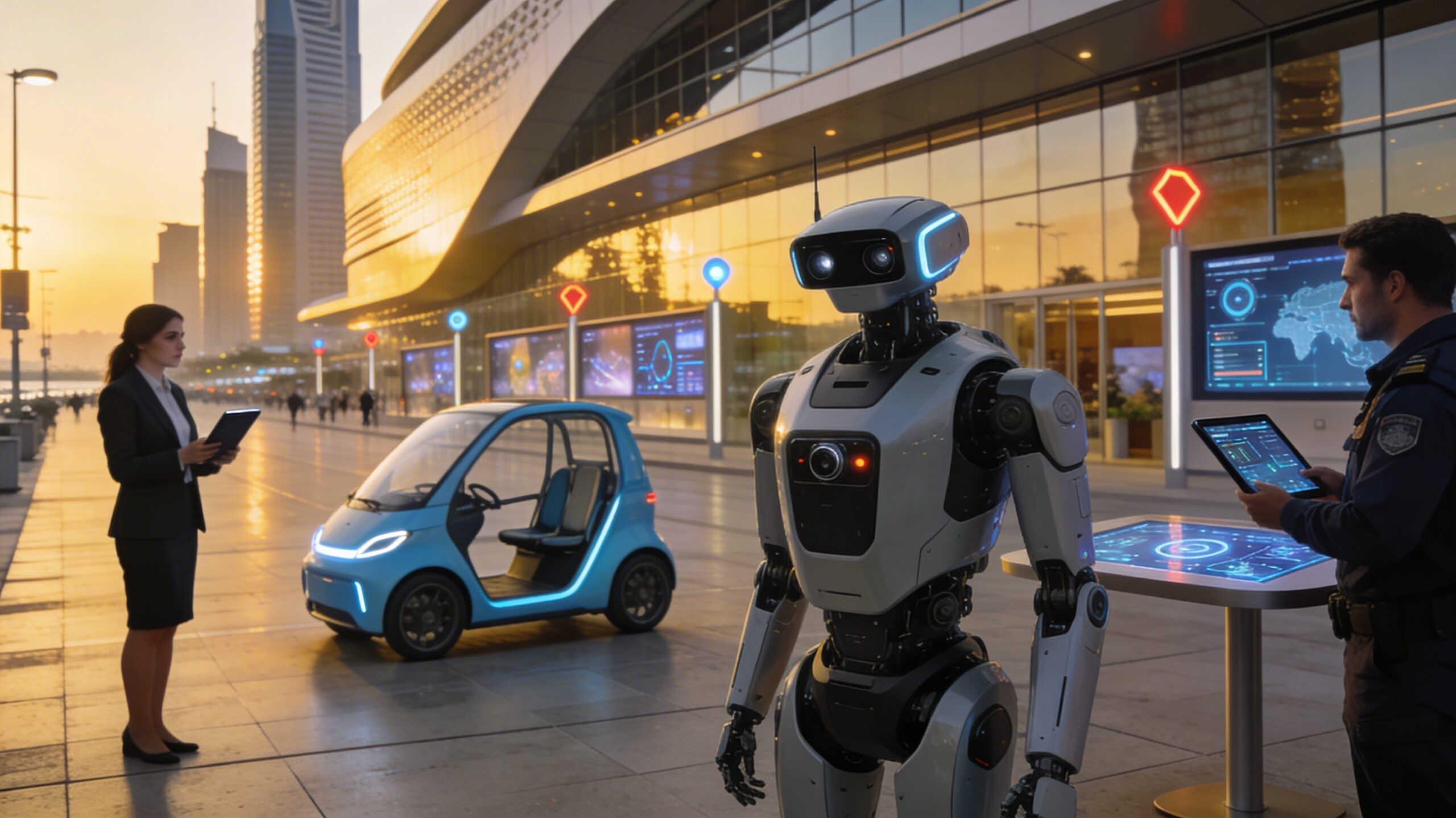
As the Middle East pushes deeper into autonomous robotics, the line between smart deployment and dangerous overreach is getting thinner.
When the conversation turns to the future of autonomous robotics, the discussion often drifts into extremes. On the one hand, the picture that emerges is utopian: perfectly organized smart cities, fully automated services, and machines that take over routine processes on a massive scale, leaving humans to handle only the creative aspects and oversight. On the other hand, there is a negative scenario: armed robots without proper oversight and a high likelihood of delegating important decisions to machines that do not understand the complexity of the real world.
As always, the truth lies somewhere in between. For the Middle East, the most valuable systems in the near future will be useful robotic systems that do not replace people but help them work more effectively: they provide more information, expand opportunities for safety monitoring, and help make strategic decisions more quickly based on the analysis of large amounts of data.
Modern artificial intelligence systems are powerful, but still limited. Many autonomous systems can quite successfully identify patterns, generate solutions, and assist in solving narrow, well-defined tasks; however, they lack a true understanding of the nuances of a situation in the same way that humans understand context. Discussions about autonomous technologies should not be limited to what they are capable of from a technical standpoint – it is far more important to understand how safe their use is for people, who will be held accountable for their decisions and mistakes, and whether they provide real benefits in everyday life and society as a whole.
The most important principle in autonomous robotics today is simple: critical decisions must always be monitored and made by humans. In this case, it is not a matter of debating with a robotic system on a philosophical level or criticizing ideas generated by artificial intelligence. If a decision could affect human safety, freedom, or has serious financial consequences, a human must remain involved in the decision-making process.
This is particularly relevant in a real-world urban setting. When we talk about the urban environment, we understand that it bears no resemblance to the conditions in a controlled laboratory. A city is unpredictable, crowded, and socially complex. Systems deployed in such environments must be designed to handle ambiguity, account for edge cases, and inspire public trust.
For this very reason, the future of public-facing robotics must follow a model that essentially boils down to “observe, but do not make decisions on your own.” In the context of public safety, this means that autonomous systems can collect data, detect anomalies, and relay information to an operator, while the final decision remains with trained professionals.
To understand how autonomous robotics will develop, we can draw an analogy with self-driving cars. Society did not accept them simply because the technology had been tested by companies. Businesses had to demonstrate safety in real-world conditions – both on closed and open roads, under close scrutiny. The same logic must apply to autonomous robotics in public spaces. If a machine is expected to interact with untrained people outside the laboratory, the criteria for deployment must be based on transparent accountability and clear operational boundaries.
In late 2025, the Dubai Police officially launched an autonomous patrol to monitor, analyze the situation, and transmit data to the command center – this is an excellent example of how such systems can already cover large and complex urban areas more quickly. But the more prominent their role in society becomes, the more important the boundaries of their authority are – the rules for using urban robots are becoming clear and strict.
UAE is demonstrating a mature approach here: the region’s priority is safety, utility, and human oversight. The government is establishing a multi-tiered system of regulations and oversight – from the federal to the municipal and sectoral levels. This is an important step toward supporting new technologies while ensuring transparency of operations, safety of use, and accountability for decisions, as well as protecting data.
It is also extremely important to note that civilian autonomous systems should not be designed to commit any form of violence. The difference between a robot that monitors public spaces and one that is authorized to use force is clear. Even if markets or institutions may be tempted to move in this direction, the long-term costs of losing public trust could significantly outweigh the short-term appeal.
This issue is important for the Middle East, as the region has a real opportunity to shape the narrative around the deployment of autonomous systems, thanks to rapid implementation. The UAE and Saudi Arabia possess both institutional ambition and government capacity. This places the region in a unique position to define what responsible deployment looks like in practice.
But the lesson learned from two years of hype surrounding AI is that speed alone is not a strategy. In many cases, companies have learned the hard way that replacing people too quickly leads, above all, to new costs and uncertain benefits. That is why the next stage of robotics development in the Middle East must take place where automation is already creating real operational value – for example, in logistics, inspection, infrastructure monitoring, and security.
Ultimately, the future of autonomous robotics in the region should not be determined by the criterion of spectacle. Any such initiative must be based on public trust and must under no circumstances exclude human professionals from the decision-making process.
As robotics becomes more prevalent in everyday life, it will enhance the urban environment rather than undermine it. It is precisely this approach that is most likely to create value for the government, investors, and society alike.