
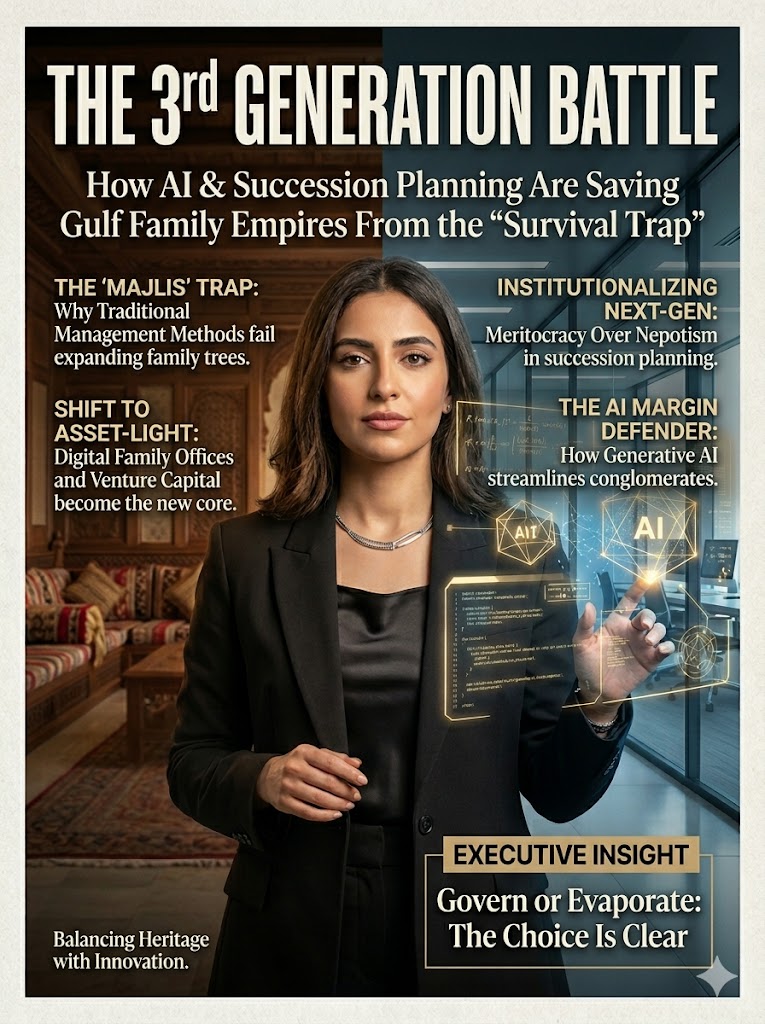
How AI & Succession Planning Are Saving Gulf Family Empires From the “Survival Trap”
Imagine a multi-billion-dollar business empire that employs thousands and anchors a nation’s non-oil GDP, yet is exactly “one family dispute away” from total liquidation.
This is not a corporate thriller; it is the raw, existential reality facing family-owned businesses across the GCC and the wider Middle East today. Historic data shows a chilling reality: only 3% of family businesses survive into the fourth generation. The rest? They dissolve in courtrooms or fracture under the weight of entitlement and expanding family trees.
But in 2026, the battlefield has evolved. The “Next-Gen” of Gulf business leaders are no longer just fighting for governance; they are staging a quiet revolution to re-engineer their fathers’ and grandfathers’ traditional assets using a powerful new toolkit: Generative AI, asset-light models, Venture Capital (VC), and, crucially, clinical succession planning.
1. The 3rd Gen Trap: Moving Past the “Majlis” Style of Management
For decades, the region’s massive family conglomerates were governed by the charismatic authority of the founding patriarch. Decisions were made based on family intuition, and capital was anchored in heavy, defensive assets: real estate, construction, and exclusive commercial agencies.
Today, as the family tree expands to include dozens of third-generation cousins, this “Majlis-style” governance is a recipe for operational paralysis. The challenge is no longer commercial; it is the urgent need to separate family harmony from operational efficiency.
This is where the Family Constitution steps in—not as a ceremonial scroll, but as a strict, legally binding operational framework that dictates:
-
The Rules of Engagement: Mandatory elite qualifications and external work experience before any family member can join the business.
-
Exit Mechanisms: Clear paths to liquidate shares without fracturing core capital.
-
The Ownership-Management Divide: Acknowledging that being an heir to shares does not automatically grant a seat in the C-suite.
2. Institutionalizing the Next Line: Succession as a Process, Not a Crisis
The fatal mistake many family firms make is treating leadership transition as an abrupt event triggered by a crisis. In contrast, top-tier strategic frameworks view succession as a multi-year, highly calculated process.
Modern succession planning among the region’s elite groups relies on two uncompromising pillars:
-
Meritocracy Over Nepotism: Automatic succession is dead. Next-Gen leaders are now subjected to rigorous competency matrices audited by independent nomination committees, openly competing with external, non-family executives for leadership roles.
-
The “External Incubation” Mandate: Modern family governance codes increasingly require next-gen heirs to work and rise through the ranks outside the family business for 3 to 5 years (in investment banks, global consulting firms, or by building their own tech startups) before they are allowed a seat at the family table.
3. From Heavy Assets to Asset-Light Capital (The Digital Shift)
The most disruptive shift in Gulf boardrooms isn’t coming from external consultants—it’s driven by the Next-Gen leaders who graduated from elite global business schools and are no longer content with the slow, single-digit yields of traditional real estate.
We are witnessing a massive structural migration toward Digital Family Offices. These young executives are shifting significant portions of family liquidity away from brick-and-mortar operations and into:
-
Venture Capital (VC) Funds: Securing early equity in the industries of tomorrow.
-
Direct Tech Investments: Prioritizing high-margin, asset-light business models, particularly in the FinTech and AI infrastructure spaces.
4. Generative AI: The Ultimate Margin Defender
Smart family enterprises have realized that governance applies to processes just as much as people. In a macroeconomic environment defined by rapid shifts, Generative AI has become the weapon of choice for the Next-Gen to trim legacy fat.
How is this reshaping the conglomerate?
-
Advanced Financial Engineering: Deploying proprietary AI models to precisely forecast Free Cash Flow and dynamically manage risk across highly diversified holding portfolios.
-
Radical Operational Efficiency: Dismantling decades of bureaucratic red tape and redundant corporate layers through smart automation—ultimately expanding Operating Margins and priming the conglomerate for future IPO readiness.
The Executive Insight: Govern or Evaporate
In 2026, corporate governance for family businesses is no longer a legal luxury or a PR badge; it is an absolute mechanism for existential survival.
The family empires that will dominate the coming decades are those whose leaders have the courage to:
-
Institutionalize Emotion: Completely separating the Family Council from the Corporate Board.
-
Architect the Second Line: Relying on objective, merit-based succession planning rather than birthright.
-
Execute the Digital Pivot: Translating legacy wealth into agile, future-proof, AI-integrated assets.
A Message to Family Chairmen: “If your conglomerate is still governed by first-generation dynamics, and your assets remain locked in traditional silos without incorporating AI-driven margins and institutional succession, you are not passing down an empire to your children—you are passing down a ticking time bomb.”