
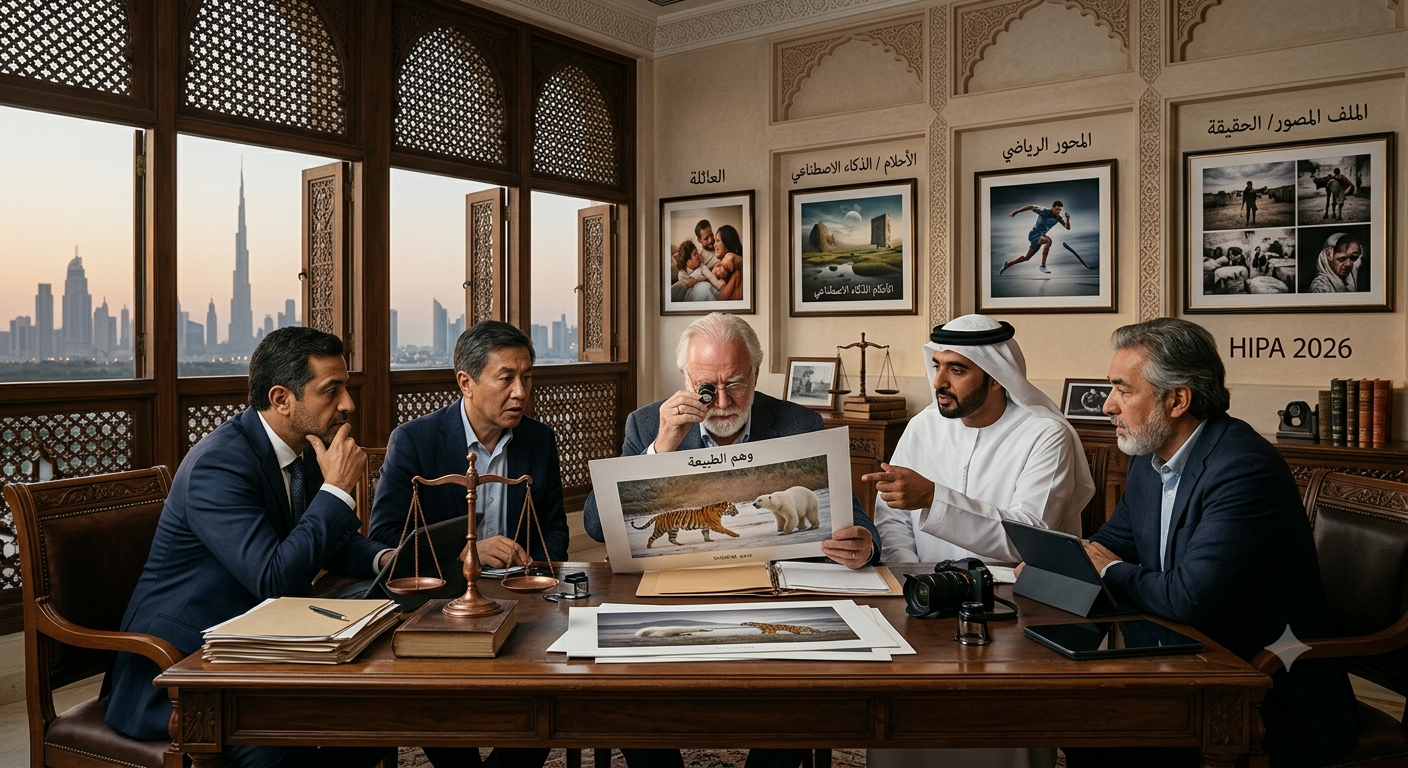
To judge a photograph is not merely to look at it. It is not a matter of fleeting preference, nor an exchange of impressions shaped by temperament or taste. At its highest level, photographic judging resembles a complete artistic inquiry: evidence is examined, intention is considered, craft is weighed, and truth itself is called to the stand.
The more prestigious the institution, the more complex this process becomes. Consider, for instance, the Hamdan bin Mohammed bin Rashid Al Maktoum International Photography Award, widely known as HIPA. Each year, the award returns to the world with a new theme, a new intellectual frame, and a renewed visual proposition. In this lies one of the great strengths of major photographic competitions: they do not merely repeat themselves. They regenerate. They enter each year with the vitality of a new question.
The Architecture of Categories
In 2026, HIPA’s main theme turned towards one of the most intimate and enduring structures of human life: Family. It is a theme at once personal and universal, modest in appearance yet vast in implication. Around it stands a carefully designed architecture of categories, some permanent, others responsive to the changing pulse of the world.
The permanent categories form the backbone of the award. The General category, in both Colour and Black & White, offers two distinct yet timeless languages. Colour brings the world in its fullness and immediacy; black and white distils it into structure, contrast, memory, and mood.
Alongside these are the changing categories, which respond to specific areas of human action and visual culture. Sports Photography, for example, is not simply about recording athletic performance. At its best, it captures the dramatic compression of time: the instant in which discipline, fatigue, risk, instinct, and beauty converge.
Then there is the renewed category, Dreams, which this year invites particular reflection. The dream image is not always available to the camera in its ordinary encounter with the world. It may exist first as a tremor in the imagination, as a scene half-seen by the mind before it is ever shaped by light. Here, artificial intelligence enters not as a replacement for the photographer, but as an instrument within the expanding grammar of image-making. Its role, when used with artistic responsibility, is not to abolish authorship, but to extend the reach of visual imagination.
The Crown Jewel: The Photo Story
Yet among all categories, the Photo Story remains, in many respects, the crown jewel of photographic practice. It belongs to the enduring realm of documentary and photojournalistic truth. It is the space where images cease to be isolated moments and become sequences of witness, memory, and consequence.
This is also why the Photo Story will remain resilient, regardless of how advanced artificial intelligence becomes. AI may generate a scene, but it cannot have been there. It cannot carry the burden of presence. It cannot stand in the dust, wait in the rain, walk through fear, or witness history unfolding before the human eye.
Truth, in documentary photography, is not merely visual plausibility. It is an encounter. It is the result of being present before reality, and of returning with evidence shaped by conscience, timing, and vision. For that reason, the Photo Story remains one of the most profound reservoirs of meaning in contemporary photography.
Inside the Judging Room
Behind the final selection lies an immense and largely unseen labour. The arrival of thousands upon thousands of images and visual stories from across the world requires not only taste, but structure; not only sensitivity, but discipline.
The first stages of judging are therefore necessarily rigorous. Technical review, compliance with rules, authenticity checks, and category-specific assessment all play an essential role before any image reaches the later stages of aesthetic and conceptual debate.
This is where specialisation becomes indispensable. It would be unfair to ask a general judge, however refined their eye, to evaluate a specialised field such as Sports Photography without a serious understanding of the game, the movement, the timing, and the difficulty of the captured instant. The same is true of wildlife, nature, documentary, and other demanding photographic disciplines. Each field has its own codes, its own truths, and its own forms of expertise.
Only after long stages of screening and deliberation does the shortlist begin to emerge. At that point, the conversation changes in tone. The jurors are no longer merely asking whether an image is eligible or technically sound. They are asking more difficult questions: What does this image reveal? What does it withhold? Does it possess visual intelligence? Does it offer surprise? Does it endure beyond the first impression?
Beauty, Truth, and the Expert Eye
But beauty alone is never enough. In serious photographic judging, the authenticity of the image must be examined with care. Outside categories that explicitly allow imaginative or AI-assisted construction, the image must remain faithful to the reality it claims to represent.
This verification can be painstaking. Figures may have been removed from an original RAW file. Elements may have been inserted. Details may have been altered in ways that transform not only the image, but the truth of the event it purports to show. Such interventions are not minor matters of polish; they can change the ethical foundation of the photograph.
A memorable incident from the Wildlife category illustrates the point.
An arresting image once appeared before the jury: two wild animals in pursuit, one chasing the other across the frame in a moment of high drama. The composition was superb. The light was luminous. The separation from the background was immaculate. Everything about the photograph seemed to suggest a prize-winning image.
Then a Dutch judge, a wildlife expert who had spent much of his life in forests, deserts, and remote landscapes, paused before the photograph. He looked at it with the quiet patience of someone who knows nature not from books alone, but from long companionship. Then he smiled and said, in effect: the photograph is beautiful, but how did these two animals meet? One belongs to the forests of Asia; the other lives only in Europe. In the natural world, their paths do not cross.
With that observation, the spell was broken. The image, for all its visual perfection, could not stand. Its beauty had been borrowed from a false encounter. It failed not because it lacked drama, composition, or light, but because it lacked fidelity to truth.
This, perhaps, is one of the enduring lessons of photographic judging. A great photograph is not merely an image that impresses the eye. It is an image that survives scrutiny. It must withstand the questions of art, technique, context, ethics, and reality.
And there are many more stories of this kind. Each opens onto another corridor of inquiry, another question about authorship, witness, imagination, and truth. These reflections are only a beginning; future essays may allow us to walk further into those rooms where light is examined, beauty is questioned, and photography is asked to account for itself.