
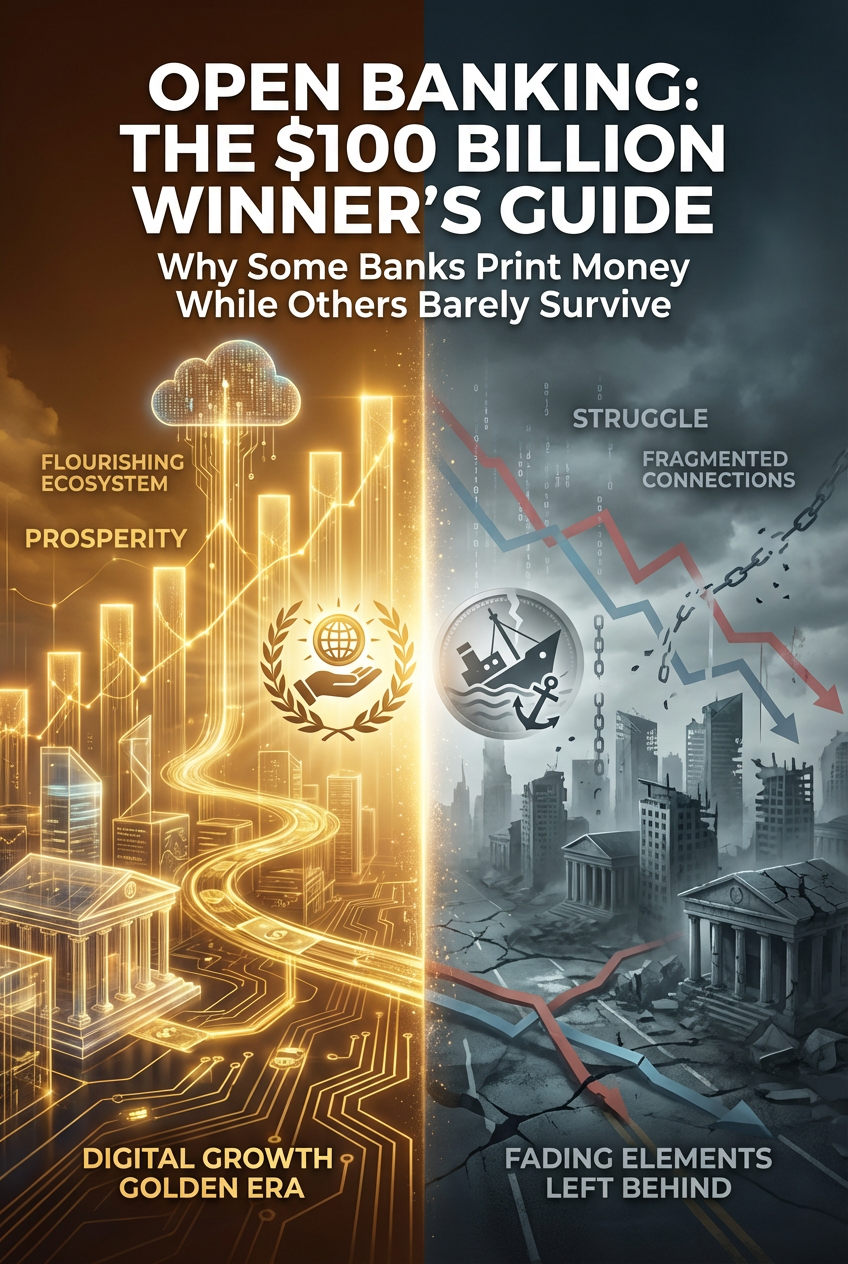
The financial industry just witnessed something extraordinary. While most of us were distracted by other headlines, some savvy banks quietly turned a massive regulatory headache into a revenue goldmine.
The numbers do not lie. Global open banking revenue hit $28 billion in 2024. By 2030? We are looking at a staggering $100-136 billion. However, here is the twist that keeps bank CEOs awake at night: while some institutions are practically printing money, others are struggling just to break even using the exact same tools.
The gap between the winners and losers is not about having deeper pockets or better technology. It is about strategy, execution, and honestly, just understanding what human beings actually want.
So, What Actually Is It?
Let us strip away the corporate jargon for a second. Open banking is brutally simple. It is a system where banks share your financial data with third parties through standardized APIs but only if you say it is okay.
Think of it like this: for decades, banks kept data in a locked vault where only they had the key. Open banking forces them to hand a spare key to the customer. Now, you decide who gets to see inside.
This shift is fundamental. Your checking account history, transactions, and spending habits can now fuel apps that help you budget better, get approved for loans instantly, or pay bills without the headache. The bank provides the plumbing; third-party developers build the cool features we all love. When it works, everybody wins.
The Great Divide: Thriving vs. Surviving
Why are some banks popping champagne while others are writing off losses? Let us look at the scoreboard.
The Winners
TrueLayer is a prime example. They now control 40% of UK open banking payments and managed to grow e-commerce transactions by 500%. How? They did not just tick a compliance box. They made it ridiculously easy for merchants to integrate. Giants like Ryanair, Just Eat, and Booking.com did not sign up because they love regulation; they signed up because TrueLayer was cheaper than credit cards and converted more sales.
Then there is BBVA. They transformed from a traditional Spanish bank into a tech powerhouse. They built an entire API marketplace where developers actually pay them for access. They went from grudgingly sharing data to actively monetizing the whole ecosystem.
Even JPMorgan Chase flipped the script. Instead of treating data sharing like a cost center, they charge fintech companies like Stripe premium fees for access. When Jamie Dimon’s institution starts monetizing data access, you know the business model has graduated from theory to reality.
What do these winners share?
- Obsessive focus on value: They solve real problems. e.g., Loan approvals drop from weeks to hours.
- Tech that works: Their APIs have 99.5% uptime. Developers do not want to throw their laptops out the window trying to use them.
- Ecosystem thinking: They treat fintechs as partners, not enemies.
- Alignment: Risk, compliance, and business teams actually talk to each other.
The Losers
The failures are just as educational. Take Money Dashboard, which shut down in October 2023. Great app, beautiful design, but they forgot one thing: people need a reason to check a budgeting app every day. Without daily engagement, the value proposition collapsed.
In France, multiple banks created APIs that were technically compliant but deliberately difficult to use blocking payments and limiting rates. They followed the letter of the law while ensuring nobody could build a business on their platform. The result? They are capturing zero revenue while their UK neighbors generate billions.
In the US, several major banks sat on their hands waiting for regulatory clarity on Section 1033. Meanwhile, institutions serving 100 million consumers adopted voluntary standards (Financial Data Exchange). The banks that waited are now playing a painful game of catch-up.
The common threads of failure? A “compliance-only” mentality, fragmented systems, and ignoring consumer trust. When 33% of consumers worry about hacks and 27% fear sharing personal info (according to Mastercard), you cannot just ignore security concerns and hope for the best.
The Global Money Map
Geography plays a huge role in who is winning right now.
- Europe: Still the heavyweight champion with 36.4% of the global market. The UK alone processed 27.2 million open banking payments in March 2025 (that is 7% of all instant payments!). Germany was already generating $1.8 billion annually by 2024. The secret sauce? PSD2 regulation created a universal standard.
- United States: A different path, but same destination. Driven by market pressure rather than regulation, revenue hit $7.14 billion in 2024 and is on track for $30.9 billion by 2030. Banking-as-a-Service (BaaS) exploded, with 30% of banks over $1B in assets adopting it.
- Asia-Pacific: The future giant. We are looking at 44% year-over-year growth in 2025. India’s UPI infrastructure is already processing billions of transactions. Regional revenue is projected to hit $29-36 billion by 2030.
- Latin America: Proving emerging markets work. Brazil leads with 9.8 million users. Mexico projects $2.83 billion in revenue by 2030.
- Middle East: Laying the foundation. Saudi Arabia launched frameworks in 2022, and with Google Pay launched, the ecosystem is forming fast.
The 5 Ways Banks Actually Make Money
Let us get to the point. How does this translate to the bottom line?
- Direct API Monetization
Simple: charge for access. JPMorgan charging Stripe is the classic example. Raw data costs $X, but enriched data (like AI-generated credit risk predictions) commands a premium. It turns commodity data into intelligence.
- Banking-as-a-Service (BaaS)
This is essentially renting out your banking license and infrastructure. Companies like Solaris and ClearBank do this beautifully. The BaaS market is growing at a 16.2% CAGR, and embedded finance could reach $291 billion by 2033.
- Transaction Fees
Currently, the biggest slice of the pie (38.4% of the market). Banks take a cut of account-to-account payments. Variable Recurring Payments (VRPs) are the golden goose here subscription payments that keep generating fees. In the UK, VRPs already account for 13% of open banking payments.
- Data Analytics & Intelligence
This is not just selling data; it’s selling answers. Real-time spending analysis tells lenders exactly who will repay a loan, or helps retailers optimize inventory. That is worth paying for.
- Marketplace Platforms
Banks like BBVA act as the conductor of the orchestra. They create a platform where third parties offer services, and the bank takes a cut through referral fees, API usage, and subscription tiers.
The Road Ahead: 2026-2030
We are looking at a global market of $75-100 billion by 2030. The US and APAC regions will likely lead the charge with roughly $30-36 billion each.
What’s next? AI-powered personalization will stop guessing what customers need and start knowing. Embedded finance means your construction software will handle your invoicing and factoring directly. And subscription-based data models will start to look a lot like cloud computing pricing.
The Verdict
The evidence is conclusive. Open banking isn’t just a regulatory hoop to jump through; it’s a multi-billion dollar opportunity. The institutions capturing this revenue the ones building robust infrastructure and treating fintechs like partners are building competitive advantages that will last for decades.
The losers? They will keep treating it as a compliance checklist and wonder why their market share is eroding.
The question is not whether to participate. The question is whether you will be the bank that prints money or the one that barely survives with the same tools everyone else has.
The choice is yours.