
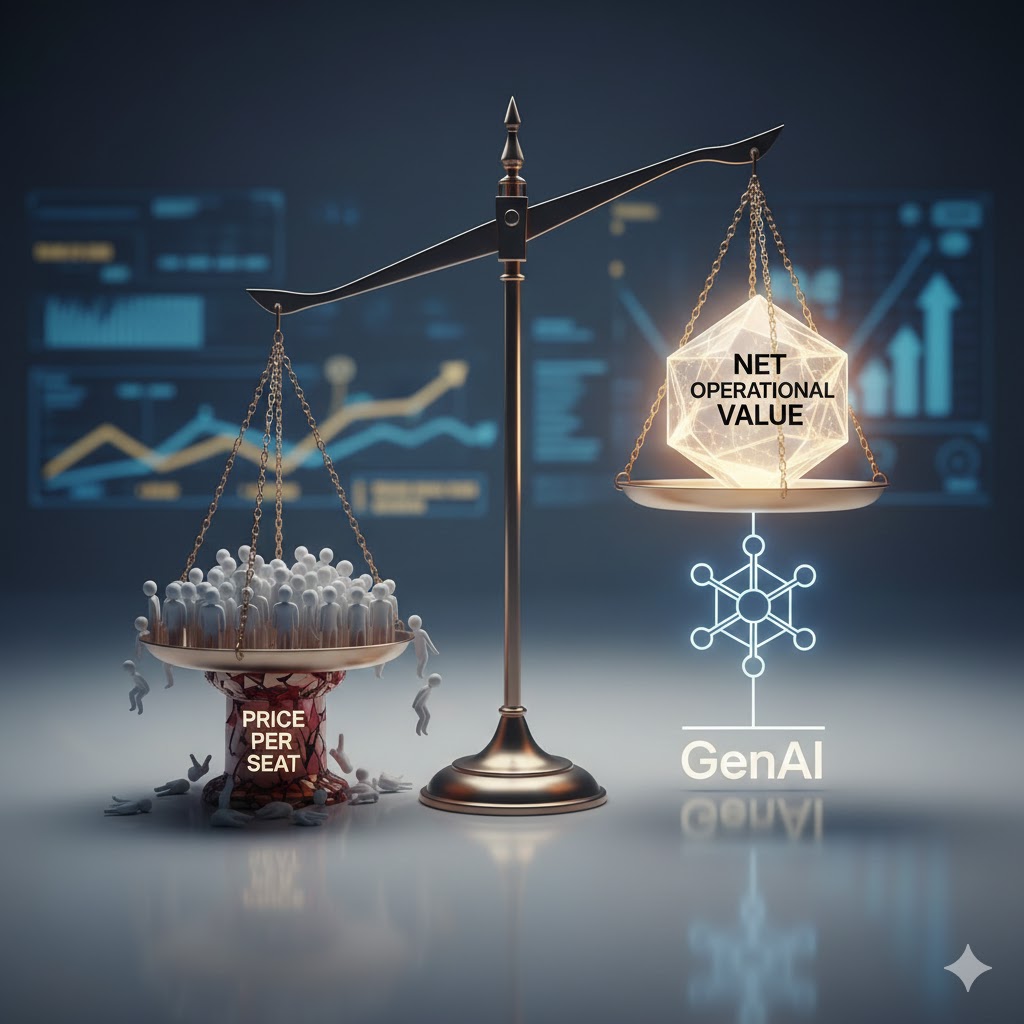
The End of “Price Per Seat”: Re-valuing SaaS in the GenAI Era.
The metric that built the modern SaaS industry is now its biggest risk.
For a decade, the investment playbook was simple: track Monthly Recurring Revenue (MRR) and seat growth. If headcount went up, revenue went up.
Generative AI has broken that correlation.
We are not facing an incremental update; we are facing a fundamental shift in human productivity that turns the traditional SaaS economic model upside down.
Today, relying on yesterday’s metrics exposes capital to structural risk.
Here is the reality of investing in the age of GenAI:
The Collapse of the “Per Seat” Model The core danger now is “seat shrinkage.” GenAI tools multiply individual output, replacing tasks that once required entire teams.
The investment trap is visible: A company selling 100 seats today might only need 40 seats in two years to achieve the same output. Early expansion turns into a silent crash in net retention.
If your valuation model relies on headcount growth in an era of radical automation, your numbers are lying to you.
The New Metric: Net Operational Value (NOV) We must shift from valuing inputs (number of users) to valuing outputs (outcomes achieved).
I propose moving to Net Operational Value (NOV). It answers one question: How much tangible value does this software generate for the client?
-
Automation Value: Can the vendor prove ROI through reduced hours, lower error rates, or streamlined processes?
-
Risk-Adjusted LTV: Lifetime Value forecasts must now account for the deflationary pressure of AI on seat counts.
The Investor Playbook for the GenAI Era. To lead in this new environment, we need a rigid framework:
1. Force a Pricing Shift: Subscription models based on seats punish high-productivity tools. We must favor usage-based or outcome-based pricing.
2. Target “Smart Growth”: Ignore slow customer count growth if ARPU (Average Revenue Per User) is accelerating due to real value delivery. Low Burn Multiples are key.
3. Assess AI Depth: Avoid companies bolting on “AI buttons” as a feature. Capital should flow to companies re-engineering entire workflows with AI at the core.
The change isn’t cosmetic; it’s structural. The companies of the future won’t just sell Software as a Service; they will sell Value as a Service.
Investors who adopt NOV today will own the landscape tomorrow.