
Reflections after the Masterclass “Foresight Through a Human Lens” for the Huawei Middle East Team
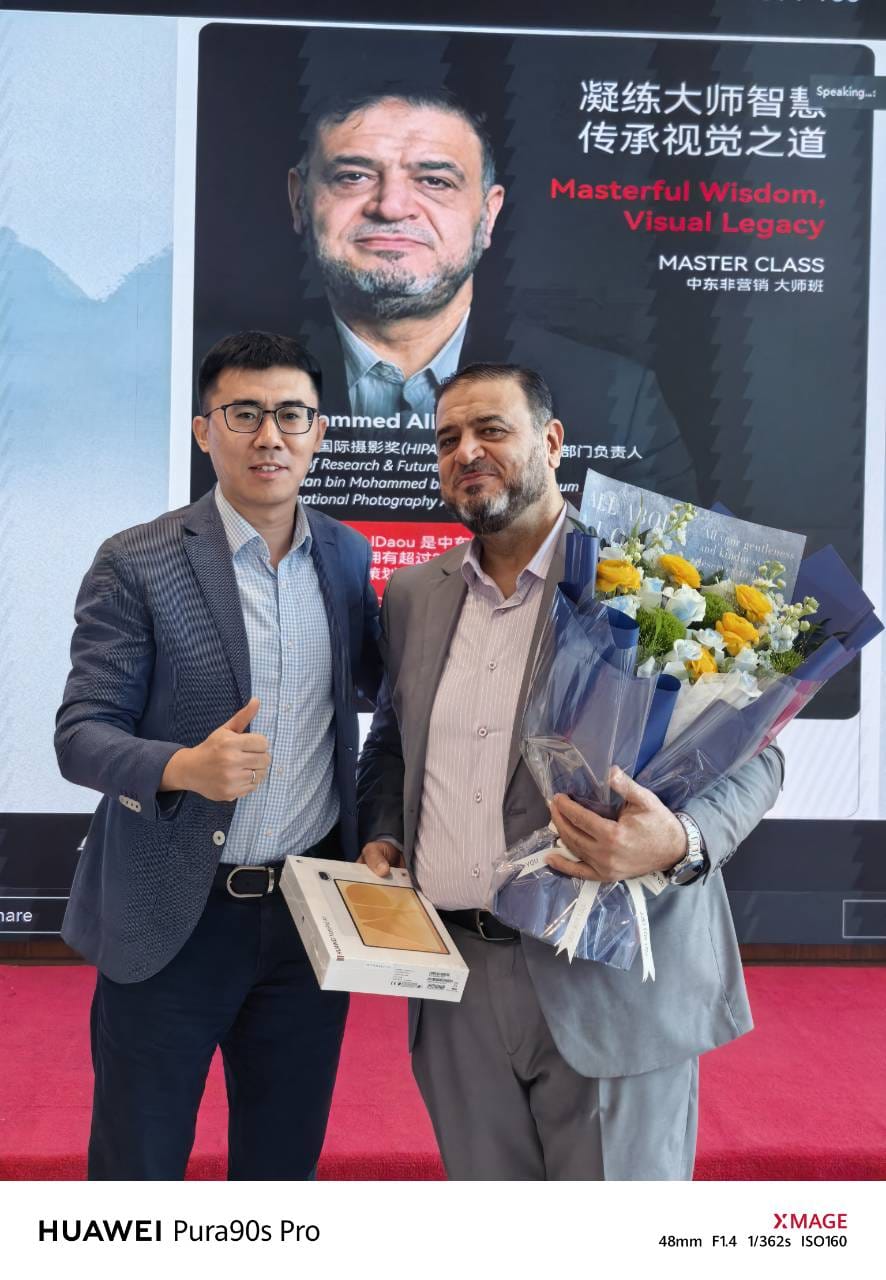
When the session ended, they presented me with a bouquet of flowers and a gift, then asked me to stand before the screen for a photograph.
I have never quite understood why photographers ask a man to smile at precisely the moment when he is least capable of manufacturing a smile. That day, the heart held more meaning than the face could display, and the mind carried more words than the entire masterclass had found time to express.
I stood beside my colleagues and friends from Huawei. One photograph was taken, then another, and finally the entire team gathered for the customary group portrait.
At first, I assumed—as people often do—that these photographs had come to announce the end of the occasion. Yet when I looked at them later, I realised that they were not photographs of an ending at all.
They were photographs of a beginning
The true value of an important gathering is not measured solely by the words spoken in the room, the number of slides displayed upon the screen, or the applause that follows the final sentence. It is measured by the doors that open after everyone has left, by the questions that remain awake in the mind after the screen goes dark, and by the idea that passes from the speaker’s voice into the listener’s will—then travels from conversation into action.
The title of my talk was:
“Foresight Through a Human Lens: How Photography Creates Sustainable Impact.”
At first glance, the title may appear to bring together two distant things: the future, which has not yet arrived, and photography, which seems able to capture only what has already appeared before the lens.
How, then, can we photograph what has not yet happened?
How can a picture taken today help us read tomorrow?
The answer lies in recognising that a photograph is never merely a record of what has been. At its most profound, it is also a signal of what may come.
A photograph of a child in an under-resourced school is not merely a document about one child; it is a question about the future of education.
A photograph of a shrinking river is not simply a sorrowful landscape; it is a warning about the future of water.
A photograph of a family gathered around a modest table does not tell us only about one household; it asks what family still means in an age in which communication expands while genuine human connection often contracts.
The honest photograph does not merely say:
“Look at what happened.”
It asks:
“Now that you have seen it, what will you do?”
And therein lies the difference between a beautiful photograph and an influential one.
Beauty may hold the eye for a moment.
Meaning awakens the conscience for much longer
People may forget an image that impressed them, but they rarely forget an image that changed something within them.
Numbers Do Not Speak Until We Give Them Human Voices
During the masterclass, I spoke about the Hamdan bin Mohammed bin Rashid Al Maktoum International Photography Award—HIPA—not to recite a catalogue of achievements, nor to place statistics upon the stage as medals are placed upon a uniform.
Numbers, however large, remain cold and silent until we restore to them the faces, efforts and stories of the people behind them.
Over fifteen main seasons, HIPA received 769,092 entries from 485,940 photographers representing 209 countries. Its annual themes travelled from Love of Earth and Beauty of Light to Creating the Future, Hope, Water, Humanity, Sustainability, Power, and finally Family.
HIPA_Achievements_Official_English_Translation_2026.docx
Someone may look at these figures and say, “How impressive the numbers are.”
I look at them and think, “How many human beings stand behind them.”
Behind every submission is a person who rose before dawn in pursuit of light; someone who waited for hours to capture a fraction of a second; someone who entered a distant street, climbed a mountain, crossed a desert, visited a camp, or returned to the family home only to discover that the greatest story had always been close at hand, though it had gone unseen.
In this sense, HIPA is not merely a destination to which photographs are submitted. It is also an observatory of human emotion.
Through the pictures people create, we can read what concerns them, what frightens them, what gives them hope, and what they believe deserves to be remembered.
When the world looked towards tomorrow, the theme became Creating the Future.
When crises deepened, Happiness and then Hope entered the visual conversation.
When water became one of humanity’s most urgent concerns, it became a subject through which photographers could speak.
And as questions surrounding humanity, nature, diversity, sustainability, power and family grew more pressing, they too entered the photographic frame.
These themes were not decorative titles selected merely to embellish posters. They were mirrors reflecting the changing concerns of the world.
My own journey across more than two decades of technology, research, writing, curation and visual culture has taught me that no photograph grows in isolation. Every image is a child of its time. Yet the great photographer does not settle for being merely a child of the age; the great photographer becomes a witness to it—and perhaps a guide towards what may follow.
Where Those Who Build Cameras Meet Those Who Build Vision
Before me sat the Huawei team: professionals in technology, engineering, communications, design, marketing and innovation—people whose work has helped place sophisticated cameras into the hands and pockets of millions.
As I spoke, I realised how wide the field of cooperation between us could become.
Huawei works to help the lens see more clearly in darkness.
At HIPA, we work to help the human being understand what is worth seeing.
Huawei develops speed, detail, computational capability, focal range and imaging intelligence.
We seek to develop sensitivity, discernment, ethical awareness and the ability to recognise the story hidden beneath the visible surface.
Technology asks:
How can we produce a better image?
Culture and visual education add another question:
How can the better image become a more truthful, useful and enduring image?
This is not to diminish technology. I came to photography through the doors of engineering and technical media, and I know well that a carefully designed tool can expand human possibility.
But I also know that no matter how intelligent the camera becomes, it cannot by itself understand why a photograph should be made, whom it may affect, or what consequences may follow when a person’s image is placed before millions.
The camera may register light.
Only the human being can recognise meaning.
A camera may record every line on a tired face, but it cannot understand the burden carried by its owner.
It may freeze an athletic movement in a fraction of a second, but it cannot decide which fraction of a second deserves to live for a hundred years.
That is where culture, education, ethics and visual literacy begin.
And that is also where Huawei’s technological strength and global reach can meet HIPA’s accumulated experience in education, judging, research, curation and the building of photographic communities.
HIPA has never confined itself to receiving photographs and honouring winners. It has delivered 232 training programmes benefiting 9,036 participants, including programmes for people of determination, young people, government employees, teachers, academic advisers, and inmates in penal and correctional institutions.
It has also developed humanitarian initiatives for people who are blind or visually impaired, refugees in camps, and participants in hope-centred programmes. Its books, magazines and exhibitions have carried photographs beyond the competition itself, giving them a second life in public memory and cultural knowledge.
For what is the value of a photograph if it never leaves its frame and enters life?
The Photographer Who Wept but Did Not Stop Photographing
Towards the end of the masterclass, I presented a sequence of sports photographs.
In one image, a goalkeeper flew through the air to stop the ball.
In another, a player charged forward with it.
Elsewhere, a victorious team lifted the trophy.
In another frame, a great player sat alone upon the grass, overcome by defeat.
Each photograph possessed its own strength. There was movement, timing, colour, tension and technical skill.
Yet I paused at a different photograph.
It did not show a player taking a penalty, a goalkeeper making a decisive save, or supporters erupting in celebration.
It showed a photographer with her eye pressed to the camera, while tears gathered in that same eye as she continued to perform her duty.
Within her, two identities had collided
She was the professional photographer who had to remain composed, alert and responsible for documenting the decisive moment.
But she was also a daughter of Egypt, overcome by the joy of seeing her national team win through a penalty shootout.
Her eye was wet.
Her hand remained steady.
That single photograph contained not one story, but two: the story unfolding on the field, and the story unfolding within the person documenting it.
That is why it endured.
The conventional match photograph tells us who played, who scored, who won and who lost.
This photograph tells us what victory does to the heart of a human being who must, in the same instant, be both witness and participant, professional and supporter, observer and citizen.
The deepest photograph does not merely record the event.
It reveals the event’s effect upon a human soul.
This is what we must teach the next generation of photographers.
Do not follow only the ball; look at the face that changes when the ball enters the net.
Do not photograph only the trophy; notice the worker cleaning the stands after the champions have gone.
Do not become so captivated by the brightest light that you overlook the shadows in which the deeper story may be hiding.
Many photographers fill the frame with objects.
Only a few fill it with meaning.
Photography in the Age of Artificial Intelligence
The discussion inevitably led us to the question of artificial intelligence.
What remains for the photographer in an age when a machine can create a scene that never occurred, add a cloud that never crossed the sky, replace one face with another, and make invention resemble reality so closely that the eye may struggle to distinguish between them?
I believe the photographer’s role will not diminish.
It will become more consequential.
In the past, photographers were responsible primarily for the quality of what we saw.
Today, and increasingly tomorrow, they will also be responsible for its truthfulness.
They were once questioned about composition, light and timing.
Now they must also answer questions about origin, context, disclosure, authenticity and ethical intent.
The central question will not simply be:
Was artificial intelligence used?
It will be:
How was it used?
Was its use made clear?
Did it serve the meaning of the work, or did it falsify reality?
Did it preserve human dignity, or transform another person’s life into material for spectacle?
Technology is not the enemy of art, just as the pen was never the enemy of thought and the printing press was never the enemy of the book.
But every powerful tool requires an equally powerful conscience.
Otherwise, its capabilities expand while its benefit to humanity grows smaller.
Why We Need XMAGE Youth
For this reason, I concluded the masterclass by proposing an idea that I believe could become an important next step in our shared journey:
XMAGE Youth Award
I said then, and I remain convinced now, that the greatest contribution we can make to the future is not merely to honour the finest photographers of today.
It is to educate the finest eyes of tomorrow.
The concept should not be a smaller imitation of an adult competition, asking young people simply to reproduce what established photographers already do.
It should be a developmental journey that teaches young participants how to look before they photograph, how to think before they publish, and how to respect the human being standing before their lens.
A young photographer should understand that a photograph is not merely the pressing of a button.
It is a decision.
Young people should learn when to approach and when to step back; when to raise the camera and when to lower it out of respect for another person’s grief.
They should be encouraged to photograph their homes, neighbourhoods, schools, friendships, communities and cities—not with the distant eye of a passing tourist, but with the attentive eye of someone who belongs to the place and hopes to see it become better.
XMAGE Youth could therefore be designed not simply as an award, but as a complete pathway:
Learn. Create. Receive mentorship. Compete. Exhibit. Belong to an alumni community.
The participant would not emerge merely with a winning photograph, but with a more mature visual character.
Huawei possesses the technology, platforms and reach required to engage younger generations.
HIPA brings educational methodology, ethical frameworks, judging experience, mentors and an international network of photographers.
When reach is joined with knowledge, technology with ethics, and competition with education, the result may be more than a search for a single winner.
It may become the formation of an entire generation of visual storytellers.
That, to my mind, is the true meaning of sustainability.
Sustainability is not merely repeating an event every year.
It is ensuring that every year leaves behind people capable of carrying the journey forward after us.
The Group Photograph Was More Than a Souvenir
I returned once again to the photographs taken after the masterclass.
In one, the large presentation screen appeared behind me as I spoke.
In another, my hand was extended in explanation.
In a third, colleagues from different cultures and professional backgrounds stood together before the camera.
And in another, there were flowers and a gift.
The flowers will fade.
The device presented as a gift will one day become part of yesterday’s technology.
Even the photographs may eventually disappear among thousands of other images stored on our phones.
But a sincere idea does not grow old, provided it finds people willing to carry it.
I believe this masterclass was not merely a lecture delivered by one speaker to one team.
It was a meeting between two visions
A vision that builds the tools of the future, and a vision determined to keep the human being at the heart of that future.
The gathering may open doors to joint educational programmes, youth initiatives, mobile-photography competitions, research into image ethics, mentorship projects, and exhibitions capable of carrying local stories towards global audiences.
And perhaps XMAGE Youth will become the first doorway through which we enter that wider horizon.
Yet more important than the number or names of future programmes is our agreement upon their purpose:
To create images that do not merely add to the world’s visual noise, but deepen its understanding.
Images that do not exploit people, but do justice to them.
Images that do not merely astonish the eye, but awaken the heart.
Today, almost everyone carries a camera.
Yet the world does not need more camera owners nearly as much as it needs more people with vision.
A lens may be made of glass and metal.
Or it may become a window.
A photograph may be a passing digital file.
Or it may become a testimony.
A photographer may simply be someone who was present when an event occurred.
Or the photographer may become the person who saved its meaning from being lost.
That is the future of photography we should seek together:
That technology may advance without humanity retreating.
That cameras may become more intelligent without photographers becoming less wise.
And that we may build an image-making culture whose impact is felt not only in memory—
but in life.