
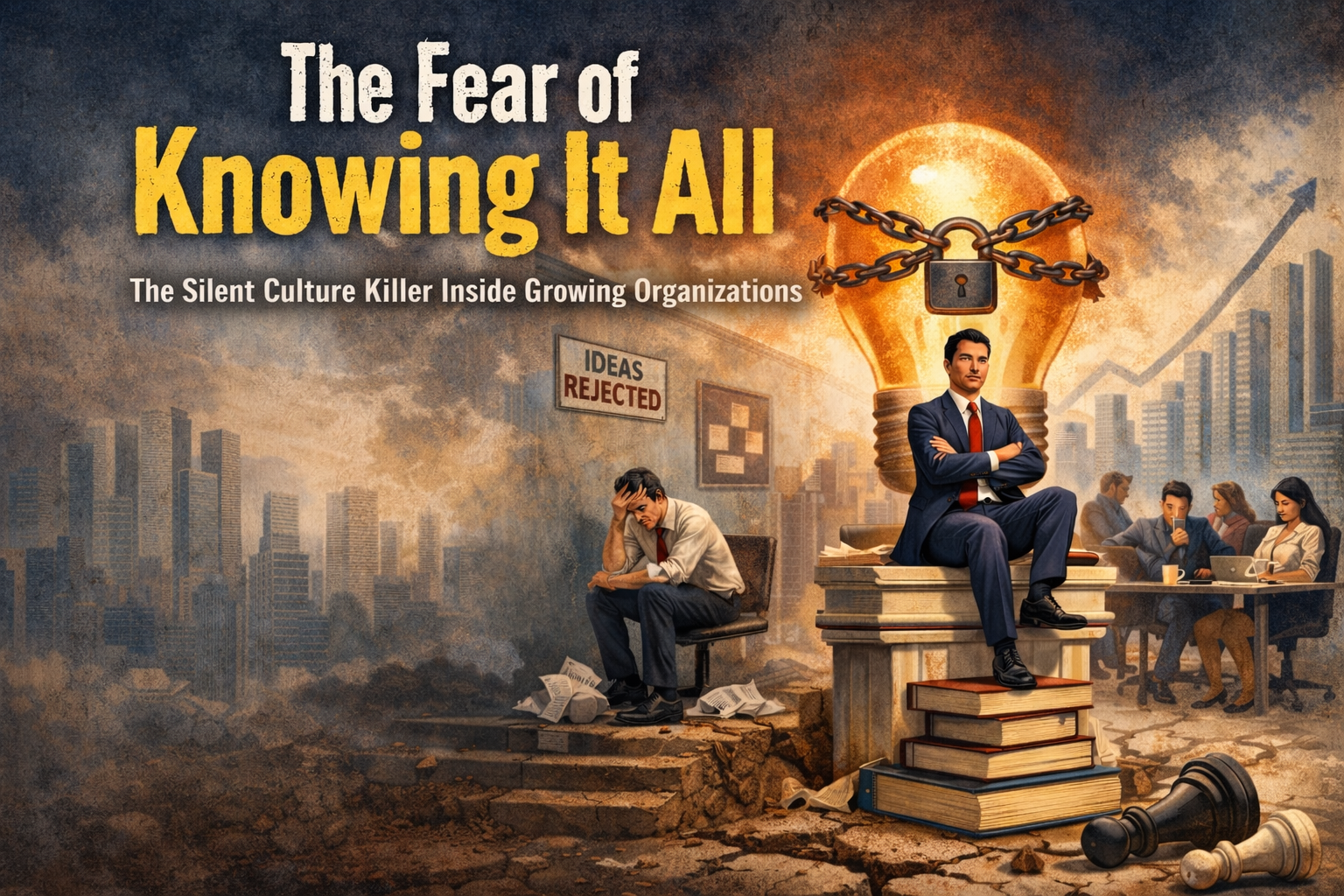
The Fear of Knowing It All: The Silent Culture Killer Inside Growing Organizations
There’s a dangerous moment in every growing organization.
It doesn’t come during a crisis.
It doesn’t happen when revenue drops.
It doesn’t show up when competitors attack.
It appears when success convinces you that you’ve figured it out.
I call it the fear of knowing it all.
And I have seen it damage companies faster than market downturns, platform shifts, or even the AI wave reshaping our industries today.
The Illusion of Mastery
When you build something from scratch, you develop instincts. You make tough calls. You survive. You win. You scale.
Then something subtle happens.
Your instincts slowly move from being hypotheses to becoming convictions.
And conviction, if not challenged, becomes rigidity.
In digital media — and especially in our region — the half-life of knowledge is shrinking. What worked in audience growth five years ago is irrelevant today. What drove CPMs two years ago is now diluted by creators, short-form platforms, and AI-driven content factories.
Yet the biggest risk to an organization is not ignorance.
It is certainty.
A Real Moment at 7awi
Around a few years into building 7awi, we were proud of our traffic numbers. We had scale. We had strong editorial brands. We were winning awards. Revenue was growing.
On paper, we were doing well.
Internally, I started hearing a phrase more often:
“This is how publishing works.”
“This is the model.”
“This is what brands want.”
It sounded logical. Experienced. Grounded.
But something felt off.
The market was changing. Platforms were tightening algorithms. Influencers were capturing marketing budgets directly. Audience behavior was shifting from long-form reading to short-form consumption.
If we had believed we “knew” publishing, we would have protected the old model.
Instead, we questioned it.
We moved from being just a publisher to building a B2B solutions-driven media group. We invested in tech. We built our own CMS infrastructure. We focused on audience segmentation, not just traffic. We expanded into events. We built CSR initiatives like Dunia Helwa to give purpose beyond numbers. We strengthened our AI workflows instead of fearing them.
That pivot did not come from certainty.
It came from discomfort.
And discomfort saved us.
Ego: The Invisible Barrier
The fear of knowing it all is rarely loud arrogance.
It is quiet ego.
It sounds like:
-
“We tried that before.”
-
“Trust me, I’ve seen this.”
-
“This is how the market works.”
-
“Let’s not overcomplicate it.”
Ego shuts down exploration before exploration begins.
And here’s the truth: the more senior you are, the more dangerous your ego becomes — because people hesitate to challenge you.
I’ve learned the hard way that the higher you go, the less direct feedback you receive. People filter themselves. They align. They nod.
Alignment can look like health.
Sometimes, it’s fear.
How “Knowing It All” Damages Culture
This mindset doesn’t just affect strategy. It impacts every layer of the organization.
1. Learning Slows at the Top
When leaders stop learning aggressively, the organization mirrors that behavior. Curiosity declines. Experimentation becomes optional.
2. Hiring Becomes Defensive
Instead of hiring people smarter than you, you hire people who agree with you. That is the beginning of stagnation.
3. Innovation Becomes Cosmetic
You talk about transformation. You attend panels. You post about AI. But internally, processes remain unchanged.
4. Feedback Becomes Polite
No one wants to challenge someone who “already knows.” So honesty disappears.
5. Talent Quietly Leaves
High performers want growth. They want debate. They want to stretch thinking. If they feel boxed in, they exit silently.
Culture doesn’t collapse dramatically.
It suffocates gradually.
The AI Trap: A Modern Example
We are living through one of the most transformative shifts in decades.
AI is not just a tool; it is restructuring productivity, cost structures, and competitive dynamics.
The dangerous reaction is not resisting AI.
It’s pretending you already understand it.
I’ve seen leaders attend one AI workshop and declare strategy complete. That is not strategy. That is comfort disguised as progress.
At 7awi, we chose a different path. We treated AI as a continuous learning curve. We built internal workflows. We tested. We failed. We refined. We created internal discussions around ethics and productivity. We embedded it inside our systems instead of just marketing it externally.
And we still don’t claim we “know” it.
We are students of it.
That mindset alone creates velocity.
Intellectual Humility Is a Competitive Advantage
Confidence is critical in leadership.
But confidence without curiosity becomes fragility.
Intellectual humility means:
-
Publicly saying “I don’t know.”
-
Letting a junior team member challenge your idea.
-
Inviting external perspectives that disrupt your thinking.
-
Re-evaluating your own strategy before the market forces you to.
One of the principles I protect internally is this: we are always early.
Even after more than a decade.
Even after building scale.
Even after awards and milestones.
The day we believe we’ve arrived is the day we begin declining.
The Hard Questions Every Leader Should Ask
If you are leading today, pause and reflect:
-
When was the last time someone openly disagreed with you?
-
When did you last change your mind because of a junior team member?
-
When did you last rebuild a system you personally designed?
-
When did you admit you were wrong in front of your team?
If the answers feel distant, you are at risk.
The fear of knowing it all does not destroy organizations overnight.
It erodes them.
First curiosity fades.
Then courage.
Then innovation.
Then relevance.
By the time revenue declines, the cultural damage has already been done.
The Real Risk Is Mental Complacency
The most dangerous leader is not the one who lacks knowledge.
It is the one who believes their knowledge is complete.
Markets evolve. Talent evolves. Technology evolves.
If your thinking solidifies, your organization eventually will too.
Stay uncomfortable.
Stay curious.
Stay a student.
Because the moment you think you know it all is the moment your competitors quietly start catching up.