
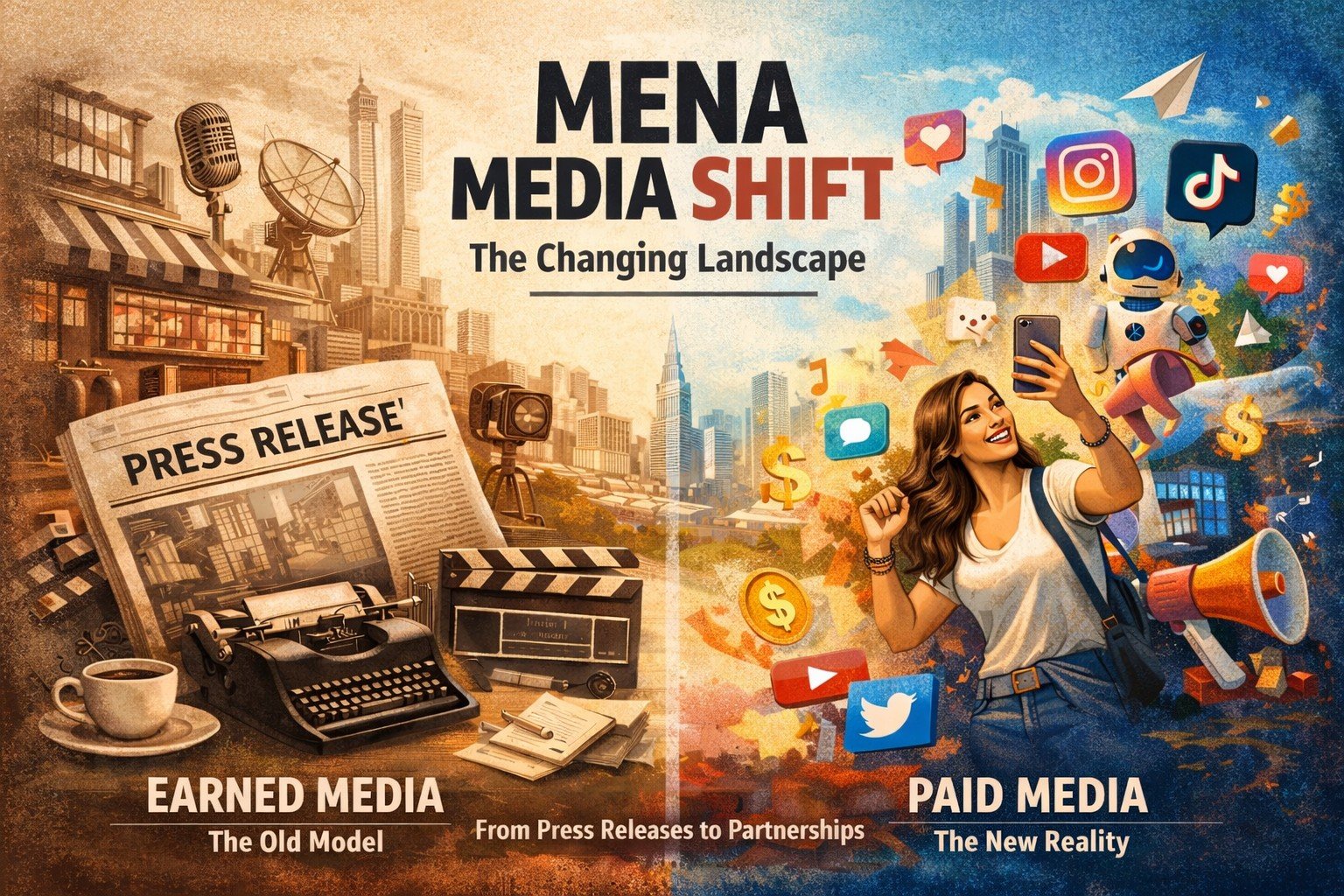
Earned vs. Paid Media in MENA: The Model Is Broken, and We’re Pretending It Isn’t
For decades, the formula was simple.
Brands hired PR agencies. Agencies issued press releases. Publishers published them. Everyone pretended it was “earned media.” Advertising budgets quietly kept the ecosystem alive.
That world is gone.
In the MENA region, the shift has been particularly dramatic. The past ten years have rewritten the economics of publishing. Social platforms captured attention. Influencers absorbed brand budgets. AI accelerated content production. And publishers—once the gatekeepers of distribution—were squeezed from both ends.
Yet many brands still operate as if it’s 2012.
Let’s unpack the difference between earned and paid media, why the model flipped, and why publishers—myself included at 7awi Media Group—no longer see press release publishing as a value proposition in itself.
The value today is not in publishing.
The value is in curation, context, and commercial alignment.
What Earned Media Used to Mean
Earned media was once exactly that: earned.
It meant editorial coverage secured through relationships, storytelling, relevance, and timing. A journalist would evaluate the merit of a story. If it was strong enough, it would make it into print or online. No invoice attached.
Publishers were financially stable because advertising funded the newsroom. Banner ads, homepage takeovers, print spreads, sponsored supplements—these generated predictable revenue.
More content meant more inventory.
More inventory meant more ads.
More ads meant sustainable publishing.
PR and editorial lived in parallel but connected worlds. The model worked because ad revenue subsidized editorial independence.
In the MENA region, this model flourished from 2008 to 2016. Traffic grew, brand budgets were healthy, and publishers were at the center of influence.
Then everything changed.
Paid Media: The Clear Transaction
Paid media is straightforward. You pay for distribution, placement, and amplification.
Sponsored articles. Display ads. Native integrations. Video pre-roll. Event sponsorships. Influencer collaborations.
There is no ambiguity.
The challenge today is not that paid media exists. The challenge is that earned media is often expected to perform like paid media—without funding the system.
That expectation is unrealistic.
The Flip: What Happened in the Past Decade
1. Platforms Ate Distribution
Google and Meta became the front pages of the internet. Algorithmic feeds replaced homepages. Traffic became dependent on opaque systems.
Publishers lost control of distribution.
In MENA, this was amplified by high social media penetration and a young, mobile-first population. Instagram and TikTok became primary discovery channels. News and lifestyle content became scrollable commodities.
The publisher was no longer the gatekeeper.
2. Influencers Captured Brand Budgets
Brands discovered something seductive: influencers delivered immediate reach and engagement.
Instead of negotiating with a publisher, a brand could wire a payment to a creator and get content live within 24 hours.
It felt measurable.
It felt direct.
It felt scalable.
In many MENA markets, influencer marketing budgets grew while display advertising stagnated. Publishers were no longer the default choice for brand storytelling.
3. CPMs Collapsed
Programmatic advertising commoditized inventory.
When ads are bought by algorithm, premium editorial environments struggle to justify premium rates. A fashion feature next to a luxury brand became less valuable when the same ad could appear cheaper elsewhere.
Revenue per article declined dramatically.
In the old world, publishing 20 press releases meant 20 monetizable pages.
In the new world, 20 press releases often mean negligible incremental revenue.
The math stopped working.
4. AI Made Content Infinite
AI removed scarcity from content production.
Press releases are now rewritten instantly, syndicated automatically, and distributed at scale. Content volume exploded.
But attention did not.
When supply increases infinitely and demand stays finite, value drops.
Publishing a press release is no longer a differentiator. It’s table stakes. Often automated. Frequently ignored.
Why 7awi Does Not Value Press Release Publishing as a Standalone Model
Let me be direct.
At 7awi Media Group, publishing press releases is not a business model.
If we publish a release today, it is typically for one of three reasons:
-
A commercial partner is investing with us.
-
A long-standing relationship exists with a PR agency.
-
The story genuinely aligns with our editorial strategy.
Otherwise, the economics do not justify it.
Press releases generate traffic that rarely converts. They dilute editorial quality if not curated. They consume operational resources—editing, uploading, tagging, optimizing—without proportional return.
Back in the day, volume equaled revenue.
Today, volume equals noise.
If you are counting clippings, then yes—press release distribution has a measurable output. Agencies can show coverage reports. Links can be listed. Screenshots can be compiled.
But clippings are not influence.
Clippings are proof of placement.
The real value lies in how the story is framed, where it sits, how it connects to audience interests, and whether it drives meaningful engagement.
That requires curation.
The Economics Behind the Shift in MENA
The MENA region adds unique complexity:
-
Fragmented markets.
-
Language duality (Arabic and English).
-
Varying ad maturity levels.
-
Heavy reliance on government and corporate spending cycles.
Publishers face rising operational costs: talent, technology, AI infrastructure, video production, events, and data analytics.
At the same time:
-
Ad budgets are increasingly performance-driven.
-
Brands prioritize creators over publishers.
-
Global platforms extract advertising revenue from local markets.
The result?
Publishers must diversify: events, custom content studios, B2B solutions, technology licensing, branded experiences.
The era of “free editorial exposure” supported by display ads is over.
The Courtesy Publication Culture
Let’s address the uncomfortable reality.
In many cases today, press releases are published as a courtesy.
A PR director calls.
A brand spends elsewhere in the group.
A relationship matters.
This is relationship capital at work.
But courtesy cannot scale a publishing business.
And publishers who rely solely on goodwill are weakening their own industry.
The ecosystem must mature.
Why Earned Media Needs a Rethink
Earned media still has value—but only when it is truly earned.
If a brand launches a transformative initiative, introduces real innovation, or impacts society meaningfully, editorial coverage will follow organically.
But if every product refresh expects front-page treatment without commercial alignment, expectations must be recalibrated.
Publishers are not distribution charities.
They are businesses.
And in a world where creators are paid transparently, expecting publishers to provide free amplification is economically inconsistent.
The Real Value Today: Curation and Context
The future belongs to curated storytelling.
A raw press release says:
“We launched a product.”
A curated feature says:
“Here’s why this product matters to our audience, how it fits into broader trends, and what it signals about the market.”
That requires:
-
Editorial judgment.
-
Audience data.
-
SEO optimization.
-
Design integration.
-
Strategic positioning.
It transforms noise into narrative.
And narrative drives influence.
At 7awi, across lifestyle, business, automotive, and technology verticals, we see stronger results when brands collaborate on meaningful storytelling rather than transactional placements.
Quality over quantity is not a slogan. It is survival.
Why Brands and PR Agencies Must Nurture Commercial Relationships
Here’s the strategic takeaway.
If brands value reputable publishers, they must invest in them.
Not as charity.
Not as obligation.
But as strategic partners.
Commercial relationships enable:
-
Editorial Integrity – Revenue stability allows publishers to maintain quality.
-
Long-Term Visibility – Consistent partnerships outperform sporadic placements.
-
Data Access – Audience insights improve targeting.
-
Integrated Campaigns – Events, content, social, and B2B distribution align.
-
Trust Capital – Trusted platforms enhance brand credibility.
In MENA, where relationships matter deeply, commercial alignment should not be taboo. It should be transparent.
Influencers are paid.
Platforms are paid.
Agencies are paid.
Publishers must also be paid.
The Strategic Shift Brands Should Make
Instead of asking:
“Can you publish this press release?”
Ask:
“How can we build a year-long content partnership that supports both our objectives?”
Instead of measuring:
“Number of clippings.”
Measure:
-
Share of voice.
-
Audience engagement.
-
Lead quality.
-
Brand lift.
-
Event participation.
-
Long-term visibility.
Instead of short-term bursts, invest in sustained storytelling.
That’s how influence compounds.
A New Definition of Earned
Maybe earned media needs a new definition.
Earned is not free.
Earned is credible.
And credibility is built through alignment, consistency, and investment.
The publishers who survive this decade will be those who:
-
Build diversified revenue streams.
-
Protect editorial standards.
-
Leverage AI intelligently.
-
Create owned audiences.
-
Form strategic commercial partnerships.
Those who cling to outdated earned-only expectations will struggle.
Last but not least, the Illusion of Free Exposure
The illusion that media exposure should be free is a relic of a different economic era.
We are now in an attention economy dominated by platforms, creators, and algorithms. Publishers must compete within that system while maintaining trust and quality.
That requires resources.
At 7awi Media Group, we value partnerships. We respect PR professionals. We appreciate long-term relationships.
But we are also clear-eyed about economics.
The press release as a standalone value proposition is outdated.
The future belongs to curated storytelling, commercial alignment, and strategic collaboration.
The world has changed.
The question is not whether earned media still exists.
The question is whether we are brave enough to redefine it.