
Stop Confusing Growth With Scale, They Are Not the Same Thing
Every founder I know wants to grow. Few have truly learned to scale. And in today’s business environment, particularly across MENA, that distinction can determine whether your company thrives or simply survives.
These two words get used interchangeably in boardrooms, pitch decks, and strategy offsites. They shouldn’t. Growth and scale follow different logics, demand different decisions, and produce very different companies.
Getting them confused is one of the most expensive mistakes a leader can make.
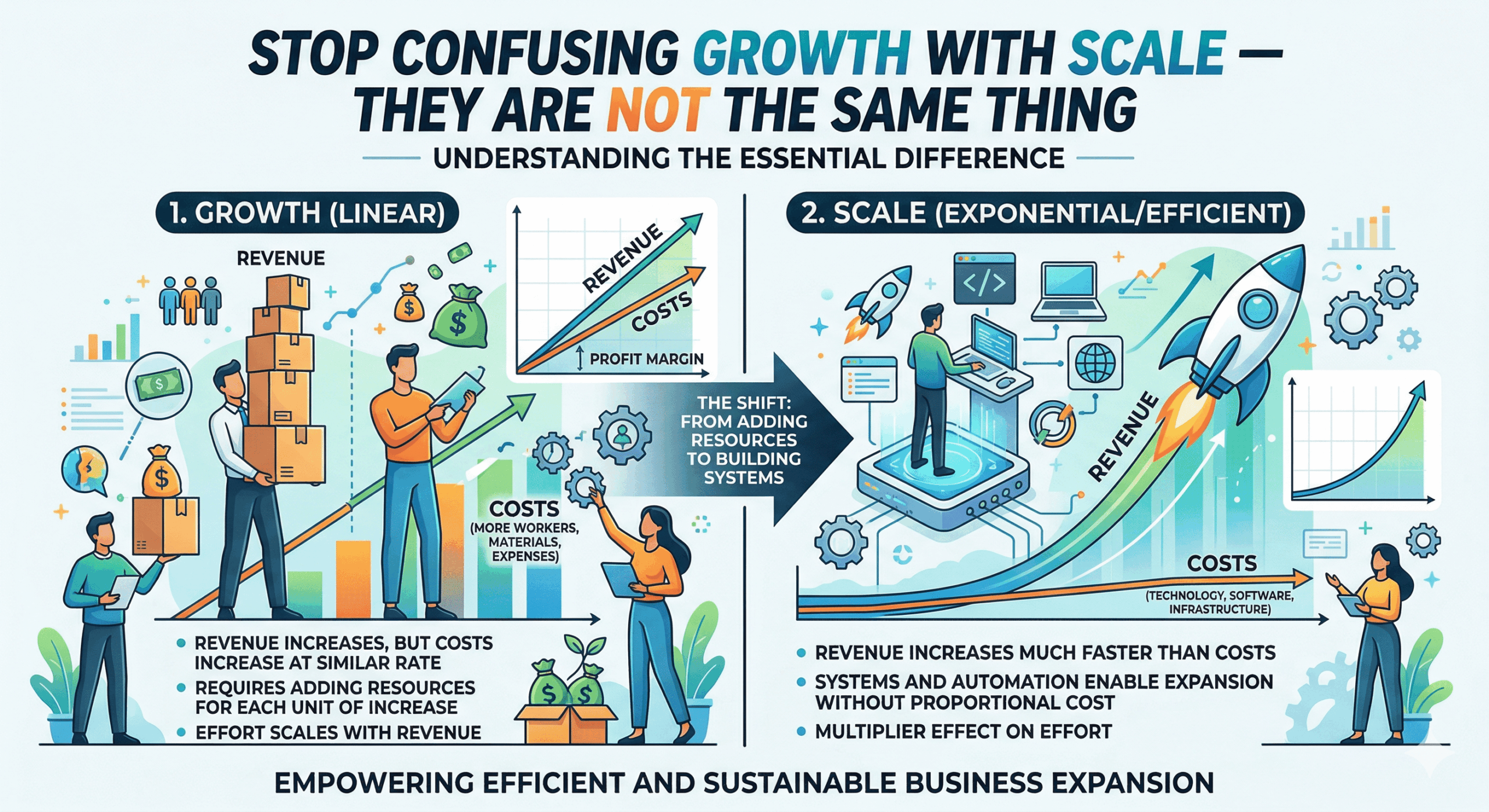
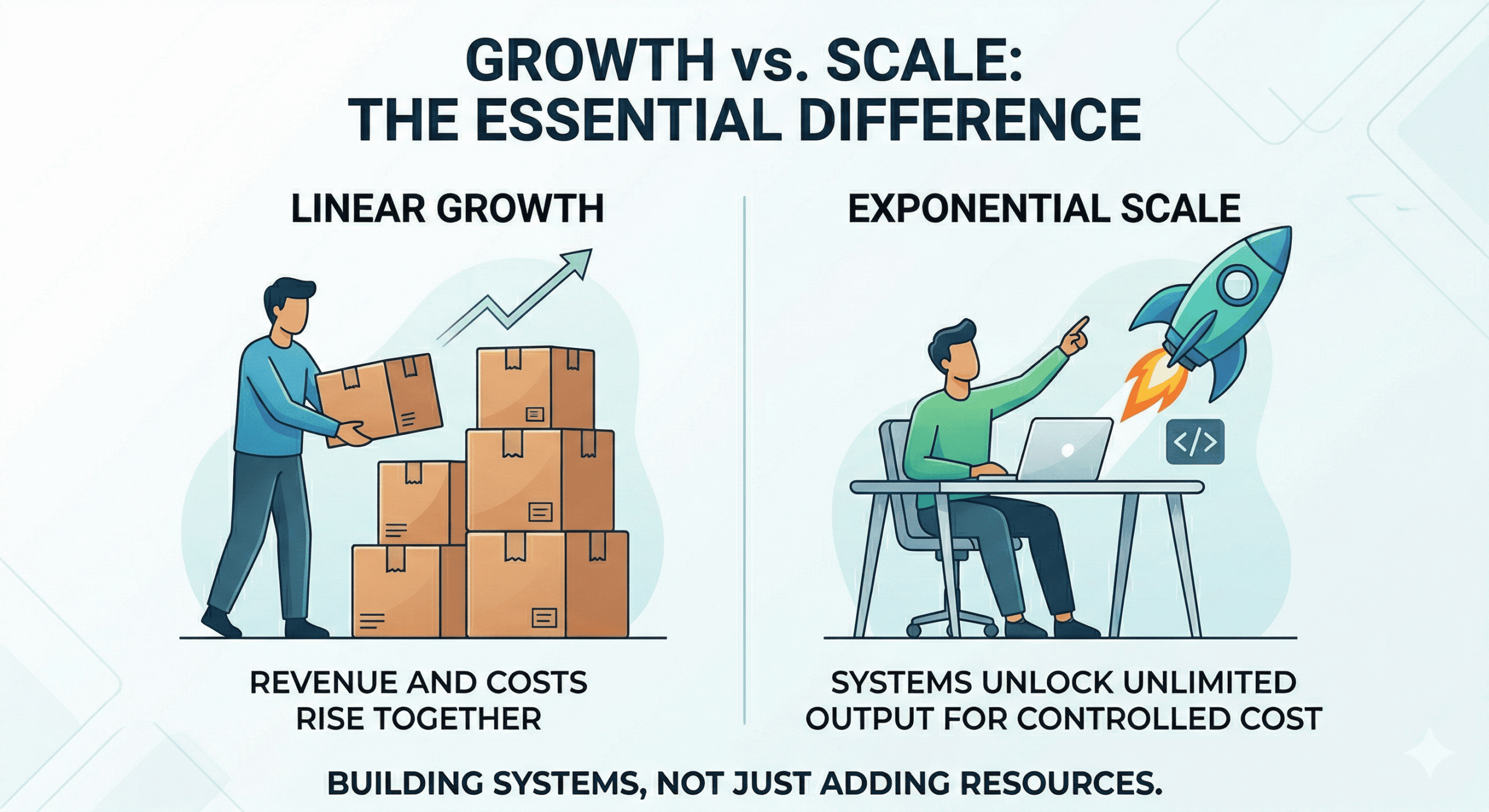
Growth is linear. Scale is leverage.
Growth is straightforward: you want more output, so you add more input. More clients, more hires, more campaigns, more markets. Revenue climbs, and that feels like success. In many ways, it is, growth is necessary, and there are seasons when pushing hard for it is exactly right.
But growth has a ceiling built into its model. No company, regardless of size, sector, or ambition, can sustain projectile growth indefinitely. The physics simply don’t hold. Every new dollar of revenue tends to come with a corresponding increase in cost and complexity. Operations become harder to manage. Execution becomes dependent on individuals rather than systems. Eventually, the business gets heavier, not stronger.
This is true for startups running out of runway and for multinationals managing sprawling portfolios alike. The question was never whether growth would plateau — it always does. The question is what you’ve built by the time it does.
Scale works differently. Scale is what happens when your business starts generating more value without requiring a proportional increase in effort or cost. Systems absorb what people used to carry. Technology amplifies output. The same team achieves more; the same infrastructure serves a larger base. Your cost curve and your revenue curve begin to diverge, and that gap is where real business value lives.
The shift from doing more to building more
I’ve seen both sides of this from within the media industry. At 7awi, we had periods of strong growth, expanding content output, growing our client base, entering new verticals. From the outside, the trajectory looked impressive. Internally, we felt the strain. Every new opportunity seemed to require new headcount, new processes, new complexity. We were on a treadmill, not a flywheel.
The shift happened when we changed the question we were asking. Instead of “how do we do more?”, we started asking “how do we make what we already have work harder?”
That’s a question that honestly occupies me every single day. At 7awi, we have built, over many years, a set of real assets: content capabilities, audience platforms, distribution infrastructure, technology products, distinct business units. The challenge I keep returning to is this: how do we ensure that every one of those assets is a building block for something larger? That every product informs another product. That every audience unlocks a new platform. That every business unit creates leverage for the next one, rather than operating as an isolated effort.
This is the essence of scaling: not accumulating more, but compounding what you have. Each capability should multiply the value of the others. Each investment should make the whole system stronger, not just the individual part.
The trap most companies fall into
Across MENA, I see a consistent pattern: businesses that are skilled at growth but haven’t yet made the architectural investments required for scale. Budgets are expanding. The creator economy is reshaping media and marketing. AI is accelerating production timelines. And yet many companies are still responding by doing more of the same, more campaigns, more hires, more activity, rather than asking how to build systems that multiply their capacity.
Activity is not the same as progress. A full pipeline is not the same as a scalable business. The most telling sign that a business is growing but not scaling? Every new client feels like starting from scratch. Every market expansion requires rebuilding operations from the ground up. The business is only as fast as its slowest bottleneck, which is usually a person, not a process.
Scale requires a different kind of discipline
Making the shift from a growth mindset to a scaling mindset isn’t simply operational, it’s architectural. It means asking not just “how do we win more business?” but “how do we build something that compounds?” It means being willing to say no to revenue that doesn’t fit your model, to restructure teams around systems rather than individuals, and to treat every feature, product, and business unit not as an end in itself, but as raw material for something bigger.
It also means being honest about where you are. Many leaders believe they are building for scale when they are still essentially running a more sophisticated version of a growth operation. The difference shows up in the margins, in the stress levels, and ultimately in the resilience of the business when conditions get harder.
In an environment where technology is compressing timelines, competition is intensifying, and the cost of inefficiency is rising, the question for every founder and executive should no longer be: how fast can we grow?
The question is: how well can we scale?
Growth makes you bigger. Scale makes you stronger. And in the years ahead, it will be strength, not size, that separates the companies that last from those that plateau.