
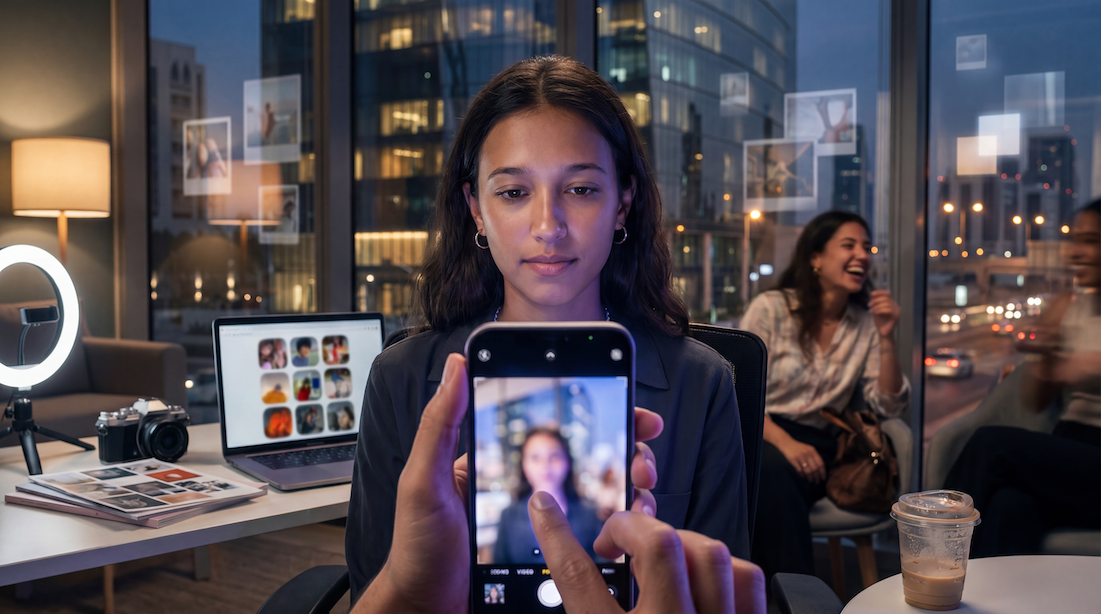
Instagram’s new disappearing-photo feature may look like a small social update, but for entrepreneurs and growing brands it points to a bigger shift: audiences are placing more value on real-time proof, smaller communities and content that feels harder to fake.
A Small Feature With A Bigger Signal
At first glance, the launch of Instagram Instants looks like a simple product move. Instagram is giving users a way to send real-time, unedited photos that disappear after being viewed or expire if left unopened. The format sits closer to direct messaging than public broadcasting, and its rules are intentionally restrictive. Users cannot upload from the camera roll, rely on filters or build the kind of polished visual story that has come to define much of the platform.
For founders and growing brands, the feature is worth watching because it reflects a wider change in digital behaviour.
Consumers are becoming more selective about what they believe online.
The more polished social content becomes, the more valuable rawness starts to feel. The more artificial intelligence improves production, the more audiences look for signals that something actually happened.
That makes Instants less of a photo feature and more of a trust signal.
The Limits Of Polished Visibility
For much of the past decade, brand building on social media has been treated as a game of visibility. Companies built content calendars, refined their grids, tested formats, invested in creators and measured success through reach, engagement and conversion. Those disciplines still matter. But the social environment around them has changed. A feed that once felt personal is now crowded with ads, creator partnerships, algorithmic recommendations and AI-assisted content. Consumers are not short of things to watch. They are short of reasons to care.
This is why Instants matters. It responds to an environment where the default social instinct has become performance. Instead of asking users to publish for everyone, it encourages them to share with someone. Instead of rewarding perfection, it rewards timing. Instead of making the post permanent, it makes the moment temporary.
That may sound like a small design choice, but for entrepreneurs it raises a larger strategic question: how can growing companies create proximity in a market where attention is abundant but trust is scarce?
Why The Gulf Context Matters
The Gulf context makes this more urgent. In Saudi Arabia, DataReportal’s Digital 2025 report recorded 34.1 million social media user identities in January 2025, equivalent to 99.6 per cent of the population. In the UAE, DataReportal reported 11.3 million active social media user identities and 99 per cent internet penetration at the start of 2025.
For founders, that means social media is not simply a marketing channel. It is where reputation, discovery, customer reassurance and purchase intent increasingly meet. In markets this connected, the question is not whether an audience is online. The more important question is whether the audience believes what it sees once it gets there.
The Rise Of Real-Time Proof
The answer is not to abandon polished storytelling. A strong company still needs a clear public identity, compelling creative assets and a recognisable point of view. But founders should be careful not to confuse polish with credibility. In many categories, especially those built on experience, community, scarcity, service or personal recommendation, the most persuasive proof may come from content that feels closer to the moment of truth.
- A hospitality founder can spend weeks producing a beautiful campaign film. That film may establish aspiration. But a real-time glimpse of a packed opening night, a chef reacting to a new menu item, or a guest sharing an unplanned moment can communicate demand differently.
- A retail founder can photograph a product perfectly for the grid, but a rougher behind-the-scenes look at packing orders or preparing for a drop may create a stronger sense of momentum.
- A service founder can publish a polished testimonial, but a quick update showing the team solving a live problem may feel more reassuring.
The value is not that these moments are less strategic. It is that they feel less staged. For companies trying to build trust, that distinction matters.
Social Is Now A Reputation Layer
This is particularly relevant in the MENA region, where social media often acts as both discovery engine and reputation layer. A report stated that 48.1 per cent of UAE users and 60 per cent of Saudi users use social networks as a primary tool for researching brands and products. That finding should matter to every founder. Your social presence is no longer only what people see after they know you. It may be the place where they decide whether you are credible at all.
The same research also highlights how fragmented digital behavior has become, with UAE users moving between an average of seven social platforms monthly and Saudi users between 7.7 platforms monthly. This means a founder is not speaking to one fixed audience in one fixed mindset. The same person may be researching, scrolling, messaging, comparing and buying in different contexts across the same day. In that environment, highly produced content has a role, but so does content that feels immediate, specific and hard to stage.
The Chat-First Lesson
There is also a chat-first lesson. The report notes that 98.5 per cent of UAE users and 96.5 per cent of Saudi users engage with messaging apps every month. That matters because Instants is not designed like a public broadcast mechanic. It sits closer to the private, conversational layer of social media, where trust is often built through smaller interactions rather than mass impressions.
The deeper shift is that growth may increasingly depend on the ability to build smaller, more believable communities. Founders are often told to chase reach, but reach without trust can become expensive noise. A million people seeing a message is useful only if enough of them believe it. In that context, features like Instants remind entrepreneurs that the next advantage may not come from being louder, but from being closer.
The AI-Era Credibility Challenge
There is an AI-era lesson here too. As generative tools make polished visuals, smart captions and localized content easier to create at scale, the baseline of production quality will rise. That will help many companies compete. But it will also make differentiation harder. When every brand can look professional, professionalism alone stops being a moat. What becomes harder to copy is access, presence, timing, community and the small imperfections that make a brand feel alive.
This does not mean founders should rush into private messaging tactics without thought. Intimacy can be powerful, but it requires restraint. The brands that use lower-pressure formats well will understand consent, relevance and context. A private-feeling channel should not become another place to push public advertising. It should create belonging, not interruption.
What Founders Should Audit Now
For entrepreneurs, the practical takeaway is to audit the balance between performance and proof. How much of the brand’s social presence is designed to impress strangers, and how much is designed to reassure people who are already close to buying, joining, visiting or recommending? Which customer experiences are being overproduced when they could simply be witnessed? Which moments are being missed because they do not fit the content calendar?
Instagram Instants may or may not become a defining feature of the platform. That is not the most important point. Its real value is what it reveals about the direction of consumer trust. In a noisy market, the future of social growth may belong to the founders who know when to lower the production value, open a smaller room and let people see something real.