
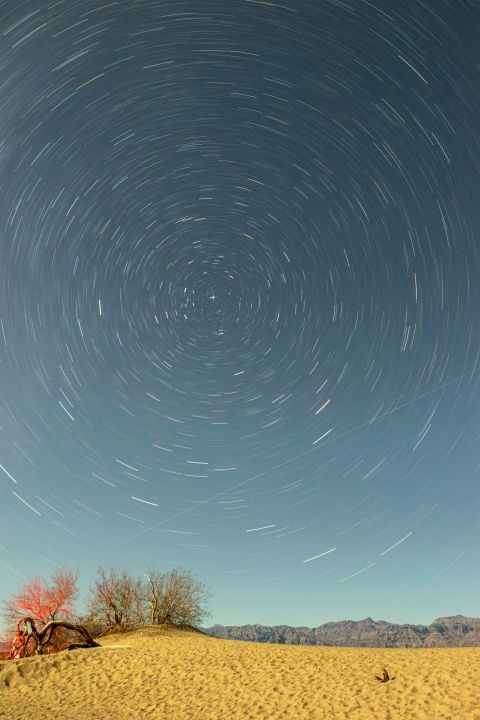
To step into the world of astrophotography is to step into a sanctuary of patience. It is a pursuit that demands you detach yourself from the hurried pace of modern life and submit to the quiet, slow rhythms of the cosmos. This is not merely a technical hobby; it is a profound exercise in resilience, where the human mind uses a small glass lens to converse with the vastness of the universe.
Knowing the Tools and Mapping the Skies
To capture the heavens, one must first master the geography of the night. An astrophotographer must read the sky like an ancient map, tracking the constellations, understanding the planetary paths, and finding Polaris—the North Star—the silent, still axis around which the entire celestial dome appears to spin.
But looking up is only half the journey; one must also look down at the earth. The photographer becomes a partner to the climate, studying the seasons, chasing the nights of the new moon, and seeking out the deepest, darkest wilderness—places like Death Valley—where the air is pure and free from the artificial glow of human civilization. A sudden shift in wind, a rogue cloud, or a spike in humidity can ruin hours of waiting. In this field, the readiness to fail, to adapt, and to start all over again from scratch is the only true path to success.
Revealing the Invisible
The true magic of this art lies in a beautiful paradox: you are not photographing what your eyes can see, but what they are inherently blind to. Human vision is limited, designed to see the night sky as a simple blanket of darkness dotted with faint sparks.
The camera, however, becomes an accumulator of time. Through long exposures, the shutter remains open, catching the faint, wandering photons that have traveled across trillions of miles of void. By gathering these tiny drops of light over hours, and later stacking hundreds of these frames together, the photographer weaves a tapestry of time itself. The resulting images reveal vibrant nebulae and perfect star trails—cosmic dances that nature keeps hidden from the casual observer, but yields to the patient heart.
Photographing the Past: The Ghosts of the Cosmos
This leads us to the most breathtaking, philosophical truth of astrophotography. The light captured on the camera’s sensor is not happening in the present; it is a traveler from a distant past.
Because of the vast distances of the universe, the light from these stars has been traveling for thousands, sometimes millions, of years. It is highly probable that some of the very stars forming these beautiful, luminous arches in our photos have already collapsed, exploded, or vanished into the expanding vacuum of space. We are, quite literally, photographing ghosts. We are drawing portraits of worlds that have already been swallowed by time, acting as cosmic historians who document a beauty that exists only as a traveling memory in the form of light.
The Lesson of the Trails
There is a profound lesson to be drawn from this dark, silent vigil. The stars teach us about the power of legacy. A star may perish, yet its light continues to journey forward, illuminating the darkness for generations born long after its demise.
Similarly, our lives and our professional endeavors require the same long-exposure patience. A great project is not built in a moment of haste; it requires a deep understanding of your tools, a vision that looks beyond the immediate horizon, and the resilience to endure the dark phases of growth. Those who have walked the path of life and accumulated wisdom owe it to the world to leave their own light behind—to pass the torch, ensuring that those who follow do not stumble in the dark, but walk guided by the steady, enduring stars of human experience.