
Two Stories. One Devastating Argument.
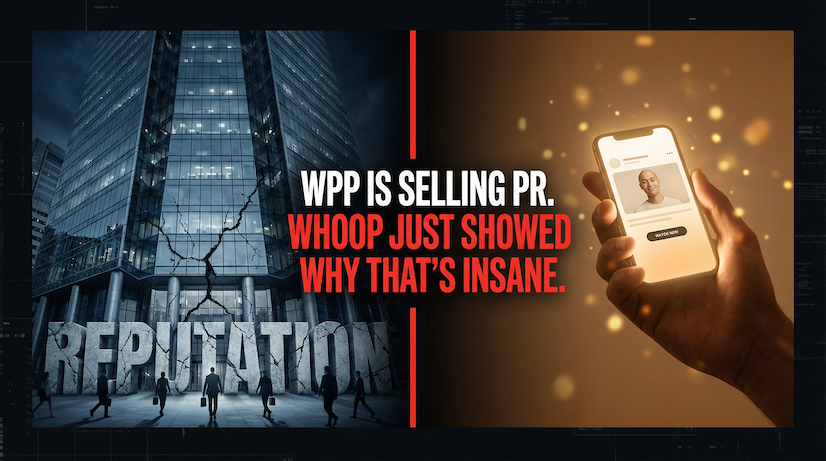
This week, two stories broke simultaneously that, taken together, make one of the most powerful arguments for public relations that the industry has ever accidentally produced.
The first story: WPP, the world’s largest advertising holding company, announced it is exploring the sale of Burson, its flagship public relations division. As part of a sweeping “Elevate28” turnaround strategy, WPP’s new CEO Cindy Rose has declared that PR is no longer a “core business.” The company is pivoting toward AI, data, and performance marketing – disciplines that offer higher margins, greater scalability, and more predictable returns. Burson, which employs 6,000 people globally and generated $894 million in revenue in 2025, is on the block. WPP has engaged Goldman Sachs to explore its options.
The second story: Whoop, a fitness wearable giant that recently raised over $500 million, filed a 111-page lawsuit against Bevel, a two-year-old software startup with a handful of employees. The lawsuit alleges that Bevel copied Whoop’s “look and feel” by using circular rings for health data, crescent moon icons for sleep tracking, and dark mode. Bevel responded publicly, calmly dismantling the claims and revealing that Whoop’s own screenshots in the complaint appeared to show Whoop had updated its app to look more like Bevel’s – not the reverse. Bevel also disclosed that two of its advisors had resigned under circumstances that pointed to pressure from Whoop. The internet, predictably, erupted.
Read these two stories together and you arrive at a single, unavoidable conclusion: WPP is selling the function that could have prevented the most self-inflicted reputational disaster in the fitness tech industry this year. And the company being sold – Burson – published the research in January 2026 that proves exactly why.
The $7 Trillion Argument WPP Is Ignoring
In January 2026, Burson – the very agency WPP is now trying to sell – published a landmark global study on the value of corporate reputation. The findings were extraordinary: corporate reputation now constitutes a $7.07 trillion global economy. Companies with strong reputations can realise as much as 4.78% in additional annual shareholder value compared to their peers. A separate October 2025 report by Echo Research found that in the United States alone, corporate reputation accounts for 26% of total market value – $13.8 trillion tied directly to how the public perceives a company’s character and behaviour.
Let that sink in for a moment. The agency WPP is selling produced the definitive research proving that reputation is worth trillions of dollars – and WPP’s response was to put it up for sale.
The argument WPP is making is structural, not philosophical. PR is people-intensive, relationship-driven, and difficult to scale within a holding company model that prizes algorithmic efficiency and predictable margins. Compared to programmatic advertising or AI-driven content platforms, a PR consultancy is messy and hard to standardise. This is a legitimate operational challenge. But WPP is making a category error: it is treating a structural business problem as evidence that the underlying discipline is no longer essential. It is the equivalent of a hospital selling its emergency department because emergency care is expensive and unpredictable, while the elective surgery wing runs on a much cleaner schedule.
The Invisible Infrastructure Problem
Every organisation has infrastructure it notices only when it fails. Power grids. Legal compliance. Cybersecurity. Public relations belongs in this category – not because it is invisible in normal times, but because its most important work is the prevention of disasters that never appear in any quarterly report because they never happened.
This is the Invisible Infrastructure Problem: organisations systematically undervalue the functions that prevent catastrophes because the prevented catastrophes leave no trace. There is no line item in a balance sheet that reads “reputational crises averted.” There is no shareholder presentation that shows the lawsuits that were filed differently because a communications professional asked the right question at the right moment. The value is real, but it is structurally invisible – which makes it perpetually vulnerable to cost-cutting exercises run by executives who measure what they can see.
Whoop has just made the invisible visible. The reputational cost of filing a 111-page lawsuit that your own evidence appears to contradict, of allegedly pressuring independent academic advisors to abandon a competitor, of sending a warm “let’s collaborate” email and then suing the recipient – these costs are now entirely visible, measurable in the volume of negative coverage, the social media commentary, and the long-term damage to Whoop’s standing in the startup and research communities.
A Deloitte study found that severe reputational damage can cause up to 30% of market value to evaporate within days. Whoop is a private company, so the stock price impact is not directly observable – but the brand equity damage is.
What a PR Professional Would Have Said at Each Decision Point
“Have you read this email back to yourself?”
The outreach Whoop sent to Bevel in June 2024 – warm, flattering, full of language about “mutual success” and “shared commitment” – is now a piece of federal court evidence. A communications professional reviewing that email would have flagged the risk immediately: if this relationship sours, this email becomes the opening paragraph of every story written about us.
Either make the partnership genuine, or do not send the email.
“If this letter becomes public, what is our headline?”
When Whoop’s legal team drafted the cease-and-desist letter demanding Bevel disable dark mode and rename “strain” and “recovery,” the legal argument may have been technically defensible. But the communications argument was not. The headline writes itself: “Fitness giant demands startup rename words used by the entire industry.” A PR professional’s job is not to override the legal team. It is to ensure the legal team has stress-tested their strategy against the worst-case public narrative before proceeding.
“What is Bevel doing with this year of silence?”
After Bevel’s lawyers pushed back and Whoop stopped responding, the legal team may have seen a tactical pause. A communications professional would have seen a preparation window – for Bevel. Silence does not neutralise a dispute. It gives the other party time to prepare their public response, gather their evidence, and rehearse their narrative. Bevel used that time extremely well.
“Have we read our own complaint as if we are a journalist?”
Before filing the 111-page lawsuit, someone needed to read it as an adversary would. The screenshots Whoop included as evidence of copying appeared, in several cases, to show Whoop’s own updated interface resembling Bevel’s design. Social media users had already noted the resemblance when Whoop updated its home screen. A communications professional reviewing the complaint would have caught this and raised a single, devastating question: “Are we about to file a document that proves the opposite of what we’re claiming?”
Why WPP’s Bet Is Wrong – And What It Gets Right
To be fair to WPP, the structural argument is not without merit. The global PR industry is undergoing genuine disruption. The rise of owned media, social platforms, and AI-generated content has changed the economics of earned media in ways that make the traditional PR agency model harder to sustain at scale. WPP’s Burson reported a 6% like-for-like revenue decline in its 2025 results. The holding company model – built on aggregating disparate agencies and extracting margin through shared services – has been under pressure for years across all disciplines, not just PR.
But there is a difference between the institutional form of PR struggling within a holding company structure, and the function of PR being obsolete. WPP is selling the former while inadvertently arguing against the latter. Burson outside WPP may actually be more effective than Burson inside WPP – freed from holding company margin pressure, able to move faster, take sharper positions, and build a clearer identity in the market.
The 2025 Edelman Trust Barometer found that trust in the technology sector has been declining for a decade across major global markets. The primary driver is not a lack of innovation. It is a persistent perception that large technology companies act in their own interests at the expense of their communities. Whoop’s lawsuit – regardless of its legal merits – has just added a vivid new chapter to that perception. And the solution to a trust deficit is not more data, more AI, or more performance marketing. It is better communication, more authentic behaviour, and the institutional discipline to ask, before every major decision: “How does this look to the people who matter to us?”
The Punchline That History Will Remember
Here is the ultimate irony of this moment. The world’s largest advertising holding company is selling its PR division because it believes the future belongs to algorithms. And the world’s hottest fitness wearable – flush with $500 million in fresh capital – just demonstrated that without the human judgment PR provides, your algorithms, your lawyers, and your balance sheet can all be turned against you by a two-year-old startup with a smartphone camera and a calm, clear story to tell.
WPP is not wrong that the industry is changing. They are wrong about what that change means. The need for someone in every organisation whose job is to ask “How will this look?” has never been greater. In a world where a single video can dismantle a 111-page legal complaint and reach hundreds of thousands of people before the defendant’s lawyers have finished their morning coffee, reputation is not a line item. It is the foundation on which everything else is built.
Whoop spent $500 million raising capital. They apparently spent nothing on someone to tell them their legal strategy was about to become a masterclass in how not to manage your brand. That is not a legal failure. It is a communications failure. And it is the most expensive kind.