
The world’s most admired companies didn’t succeed by staying the same — they succeeded by knowing when to change
There is a myth in business that the most successful companies got there by executing a perfect plan.
They didn’t.
Many of the world’s most recognizable brands started in completely different industries. Some failed at their original ideas. Others spotted a bigger opportunity and changed direction before the market forced their hand. What looked like uncertainty from the outside was actually the earliest form of innovation happening from within.
That is the lesson I keep coming back to — for entrepreneurs, for founders, and for legacy businesses navigating this moment in history: reinvention is not failure. It is often the only path to survival.
We are living through a period of extraordinary disruption. AI is restructuring entire industries. Consumer behavior is shifting faster than any five-year plan can predict. Digital platforms have rewritten the rules of reach, monetization, and relevance. In this environment, the companies that will lead the next decade are not necessarily the biggest. They are the fastest learners.
That is a principle I have applied — and continue to apply — at 7awi.
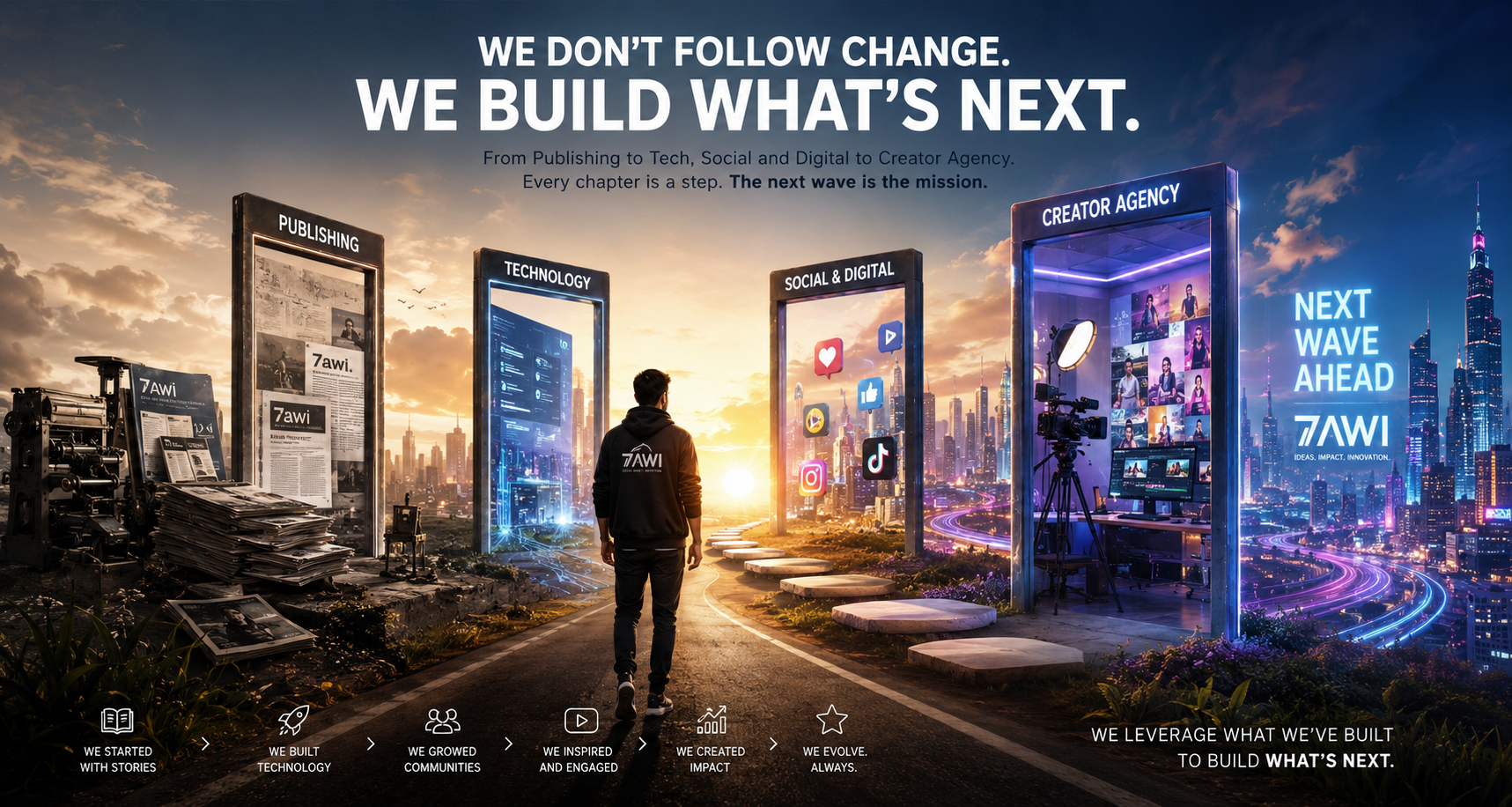
We started as a publishing business. But publishing alone no longer defines what media means. Audiences changed. Platforms changed. The economics of content changed. Technology changed everything around us. So we evolved — not by abandoning who we were, but by building on top of what we had learned.
Over time, 7awi expanded from publishing into technology, social media, video production, creator partnerships, branded content, events, data insights, and influencer marketing. We built tools. We invested in platforms. We launched creator-focused initiatives because we understood early on that the future rarely rewards companies that stay still.
Every phase was not a departure from the previous one. It was a continuation.
Our publishing roots gave us a deep understanding of audiences. That audience understanding helped us build social scale. Our social scale opened doors into the creator economy and branded content. Our operational challenges pushed us toward technology and automation. And now AI is pushing all of us — every media company, every brand, every business — to rethink the next chapter once again.
The goal was never to erase what we built. The goal was to leverage every success, every mistake, every audience, every lesson, as a foundation for what comes next.
Because if Amazon can evolve from selling books to powering the internet, and Netflix can move from mailing DVDs to producing global entertainment, then every business has a responsibility to challenge its own model before the market does it for them.
The Companies That Reinvented Everything
The history of global business is essentially a history of reinvention. A few examples worth examining closely:
Louis Vuitton did not start as a fashion house. In the 1850s, it made travel trunks — flat-topped, stackable, practical. But somewhere along the way, the brand understood something much more powerful: it was never really selling luggage. It was selling aspiration, identity, and exclusivity. Today it anchors the world’s most valuable luxury conglomerate. The product changed. The emotional promise scaled.
Amazon began by selling books online — a category chosen because it was easy to ship and had enormous inventory depth. But Jeff Bezos never defined Amazon as a bookstore. He defined it as a company obsessed with customers and scale. Today, Amazon Web Services — the cloud infrastructure business — is arguably its most profitable division. One of the world’s largest technology companies started by shipping books from a garage.
Nokia was a paper mill in Finland before it became a rubber manufacturer, then a cable company, then the dominant force in global mobile phones. After losing the smartphone race, it reinvented itself again into telecommunications infrastructure. Nokia’s story is not one of reinvention — it is a masterclass in continuous reinvention over more than a century.
Netflix began by mailing DVDs to subscribers. That model alone disrupted Blockbuster. But rather than protect that success, Netflix disrupted itself — moving into streaming, then into original content production. It became both a technology platform and a global entertainment studio. The companies that become Netflix’s competition today are the ones that waited too long to make the same shift Netflix made voluntarily.
Samsung started as a trading company selling groceries, dried fish, and noodles. Few people associate Samsung with food today. The company expanded into construction, insurance, and shipbuilding before eventually entering electronics. It is now one of the most valuable technology brands on the planet. The lesson is not about luck. It is about where leadership chose to invest its attention.
YouTube was originally designed as a video dating website. The concept failed. But the founders noticed users uploading general videos — not dating profiles — and pivoted around that behavior. What emerged became the world’s largest video platform and one of the most influential media ecosystems ever built. The market told them what the business should become. They listened.
Instagram launched as Burbn — an app built around location check-ins and gaming. The founders realized users cared about one thing above everything else: sharing photos. So they stripped the product back to that core insight. Growth does not always come from adding more features. Sometimes it comes from having the discipline to remove distractions.
Slack was born inside a gaming company whose video game failed commercially. The internal communication tool the team built to coordinate their own work outlived the game entirely. Today it is used by millions of professionals globally. Sometimes your side project is the real business.
Shopify began as an online snowboard store. The founders were frustrated by the limitations of existing e-commerce platforms, so they built their own. That internal tool became the product. The problem that frustrated them most became their biggest opportunity — and one of the most important commerce platforms in the world.
Nintendo has been in business since the 1880s — making handmade playing cards. Long before Mario existed, the company experimented with taxis, love hotels, and toys before eventually entering gaming. A company’s future identity is rarely visible from its starting point.
The Ones Who Didn’t Reinvent — And Disappeared
For every Amazon or Netflix, there is a cautionary tale of a company that had every advantage — scale, brand recognition, loyal customers, capital — and still became irrelevant because it refused to evolve.
Blockbuster had more than 9,000 stores at its peak and a chance to acquire Netflix for $50 million in 2000. It passed. Leadership bet on physical retail long after consumer behavior had moved on. By 2010, Blockbuster had filed for bankruptcy. Netflix, the company it dismissed, is now worth over $300 billion.
Kodak invented the digital camera in 1975. Its own engineer built it. But the company buried the technology for decades, afraid it would cannibalize its highly profitable film business. When digital photography finally took over, Kodak had no ground left to stand on. It filed for bankruptcy in 2012 — the victim not of competition, but of its own hesitation.
Nokia appears earlier in this piece as a reinvention success story — and it was, for a long time. But its second chapter is equally instructive. At the height of its dominance in mobile phones, Nokia dismissed the touchscreen smartphone as a passing trend. It clung to its hardware advantage while Apple and Android rewrote the software rules. Within a few years, a company that once held nearly 40 percent of the global mobile market had lost it almost entirely.
Borders was one of the largest bookstore chains in the world. Rather than build its own online retail capability, it outsourced its e-commerce operations to Amazon in the early 2000s — effectively handing its future to a competitor. When digital reading and online shopping reshaped the industry, Borders had no infrastructure to compete. It closed all its stores in 2011.
BlackBerry built the smartphone category. At its peak, it was the device of choice for executives, politicians, and professionals globally. But when Apple launched the iPhone in 2007, BlackBerry’s leadership publicly called it impractical. The company continued optimizing the product it had always built rather than rethinking what the market was now demanding. Within a decade, its market share had collapsed from dominance to near zero.
The pattern across every one of these companies is the same: they confused past success with future security. They protected what had worked instead of questioning whether it would continue to work. And by the time the market made the answer clear, it was already too late to respond.
Success, without the discipline of reinvention, is just a slower path to irrelevance.
Why Companies Resist Change — And Why That Resistance Is So Dangerous
One of the most common reasons companies struggle to evolve is emotional attachment.
There is comfort in familiarity. There is pride in legacy. There is genuine fear in changing direction publicly — in admitting, even implicitly, that the original path may not be enough. Boards resist it. Founders resist it. Teams resist it.
But markets do not reward nostalgia. They reward relevance.
This is especially true now, in an era where industries are being reshaped within years, not decades. Media companies are becoming technology platforms. Retail brands are becoming content studios. Automotive companies are becoming software businesses. The old rule — protect what made you successful — has been replaced by something more demanding: challenge what made you successful before someone else does.
The companies that will define the next ten years are the ones that treat reinvention not as a crisis response, but as an ongoing discipline. Not as something that happens to them, but as something they do deliberately, continuously, and ahead of necessity.
Reinvention Is Not Weakness. It Is Strategy.
Too many businesses still treat pivots as admissions of failure. History shows the opposite.
Some of the world’s most admired companies became what they are precisely because they changed direction at the right moment — often before the need was obvious to anyone outside the room.
The ability to evolve is not abandoning your identity. It is the most authentic expression of it. Because a business that refuses to grow eventually becomes a monument to what it used to be.
The business you start is rarely the business you were meant to build.
The companies that understand that — early enough to act on it — are the ones writing the next chapter.